
Landed cost of a US car: from the auction bid to customs clearance
Every component in the price of a US car: auction fees, ground transport, ocean freight, port charges, 10% import duty, excise and 20% VAT. The 2026 customs formula, and how to work a maximum bid backwards from margin.
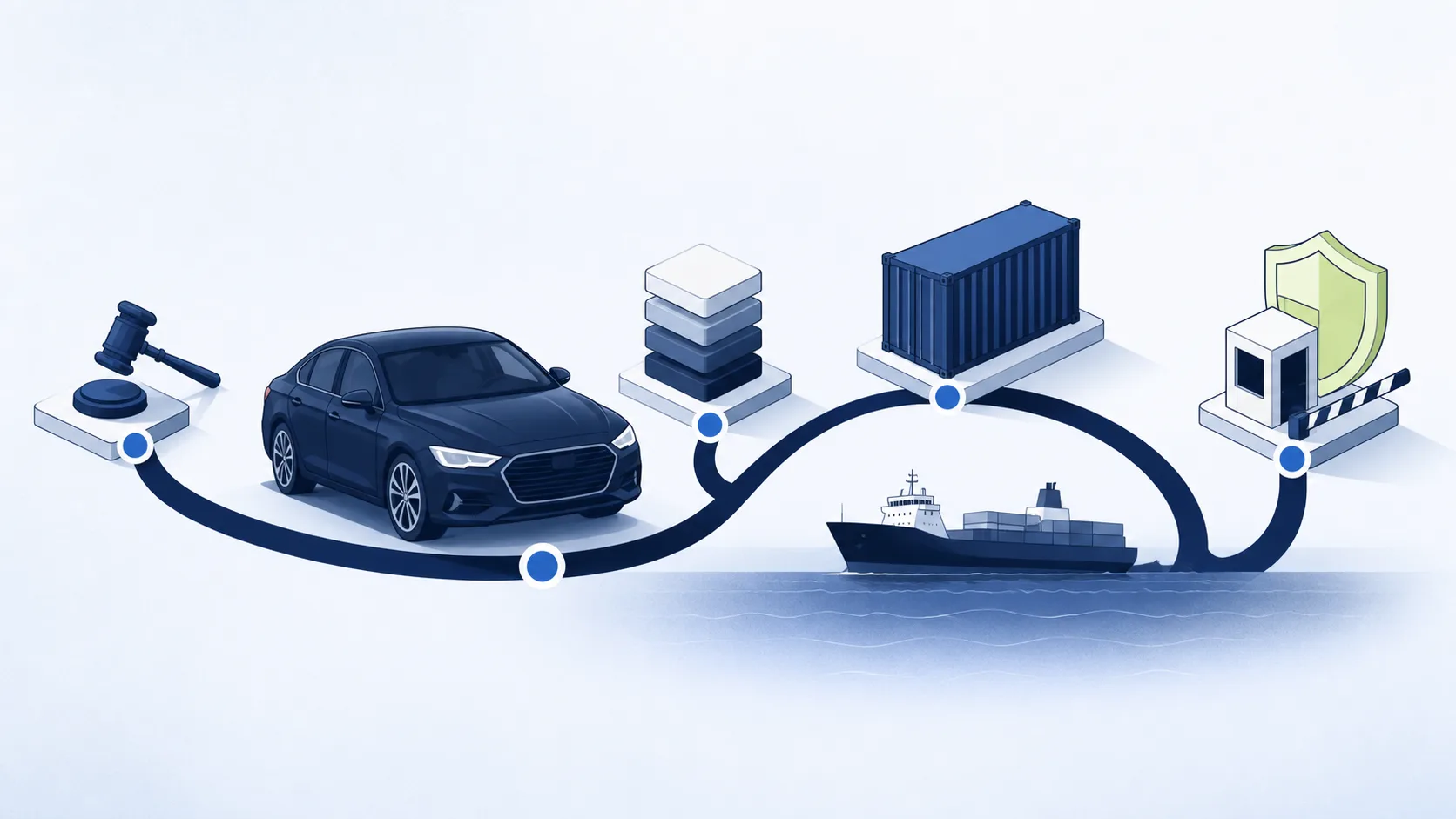
The question "how much does it cost to import a car from the US" is almost always asked the wrong way round. For a dealer the right question is the inverse: how much can I bid on this lot and still keep my margin after everything?
It is the same arithmetic run in the other direction — and that direction is what decides whether the deal makes money. Below: every component in order, the customs formula, and how to compute the bid backwards from a target margin.
What landed cost is made of
The path from the auction hammer to registration plates has four cost blocks, each with its own variance.
| Block | What it covers | Main source of uncertainty |
|---|---|---|
| 1. Auction | Bid + buyer fee, virtual bid fee, gate fee, environmental fee, title handling | Buyer tier and payment method |
| 2. US logistics | Yard-to-port transport, port charges, consolidation, loading | Distance from the yard to the port |
| 3. Ocean and arrival port | Ocean freight, insurance, unloading, port storage | Storage: the meter runs daily when documents are late |
| 4. Customs and paperwork | Duty, excise, VAT, broker, certification, registration | The customs value the authority assigns |
Block 1: auction fees
These add roughly 15–25% to the bid — proportionally more the cheaper the lot, because several charges are flat and identical on a $700 car and a $30,000 one. It is the first thing to calculate and the only block that can be known precisely before the sale.
Full breakdown of every charge in the guide to Copart and IAAI fees. The exact figure on a given lot comes from the calculator, by lot number.
Blocks 2–3: logistics
What matters here is not an average figure but what actually moves it on your lot:
- Distance from the yard to the port. A lot in a coastal state and a lot in the middle of the country are different money in ground transport. Check it *before* bidding, not after.
- Shipping method. Container (usually consolidated across several cars) or roll-on/roll-off. Affects both price and transit time.
- Vehicle condition. A car that neither starts nor rolls costs more to handle at every stage.
- Size. An SUV or pickup takes more container space than a sedan.
- Port storage. The most underestimated line: the free window is short, and any document delay turns it into a daily meter.
Block 4: the customs formula
Import charges have three sequential components. The order matters: each is calculated on the running total including the previous one. Rates below are Ukraine's, the destination most of these cars are bought for.
- 1Import duty — 10% of the customs value of the vehicle.
- 2Excise = base rate × (engine displacement ÷ 1000) × vehicle age. Age is the number of full years, capped at 15: anything older is calculated at a factor of 15.
- 3VAT — 20% of the total: customs value + duty + excise.
The excise base rate depends on engine type and displacement: for petrol engines up to 3000 cc it is €50; for diesel engines above 3500 cc it is €150. Intermediate categories carry their own rates.
The practical consequence for lot selection: engine displacement has to be a filter at the search stage, not a discovery after you win. It is the parameter dealers most often skip while focusing on lot price and damage.
On customs value
All three charges are computed from customs value, which is the least predictable variable in the whole calculation. It is not automatically your bid: the authority may work from its own assessment. For a damaged car, a properly assembled file documenting condition and repair cost is what influences that assessment — and therefore all three charges at once.
The restrictions that void the calculation
Two factors make the entire calculation moot, and both take seconds to check — before bidding:
- Title type. Junk, Non-Repairable and Certificate of Destruction may be barred from export or clearance — the car is legally no longer a vehicle. Detail in the guide to title types; the check itself is the title check.
- Origin. Vehicles originating in, or imported from, an aggressor state or the occupied territories of Ukraine cannot be cleared.
The point: compute backwards from margin
Now assemble all of it in the right direction. A dealer does not calculate "what will this lot come to" — they calculate "what can I pay for it".
- 1Expected resale price. The real market figure for comparable cars in comparable condition — not the one you would like.
- 2Minus your margin. Target margin, not "whatever is left".
- 3Minus repair. Accounting for the damage codes and the fact that hidden damage can grow the estimate.
- 4Minus duties. By the formula above — driven by displacement and age, both already known.
- 5Minus logistics. Including distance to port and a buffer for storage.
- 6Minus auction fees. Exact figure by lot number.
- 7= Your maximum bid.
That number is the line you do not cross in the lane, however much you want to. Set in advance, it protects against the defining auction mistake: adding $300 "because I have almost won it" and closing the deal at zero.
NotedCar prices the full door-to-door cost from a lot number — fees, logistics, customs — and shows the maximum bid that protects your margin.
Start 14 days free