
Copart and IAAI damage codes: which ones actually destroy your margin
US auction damage codes explained: Front End, Rear End, Side, All Over, Water/Flood, Burn, Mechanical, Undercarriage. What the Primary/Secondary pair implies, why the codes cannot be taken literally, and which damage really kills profit.
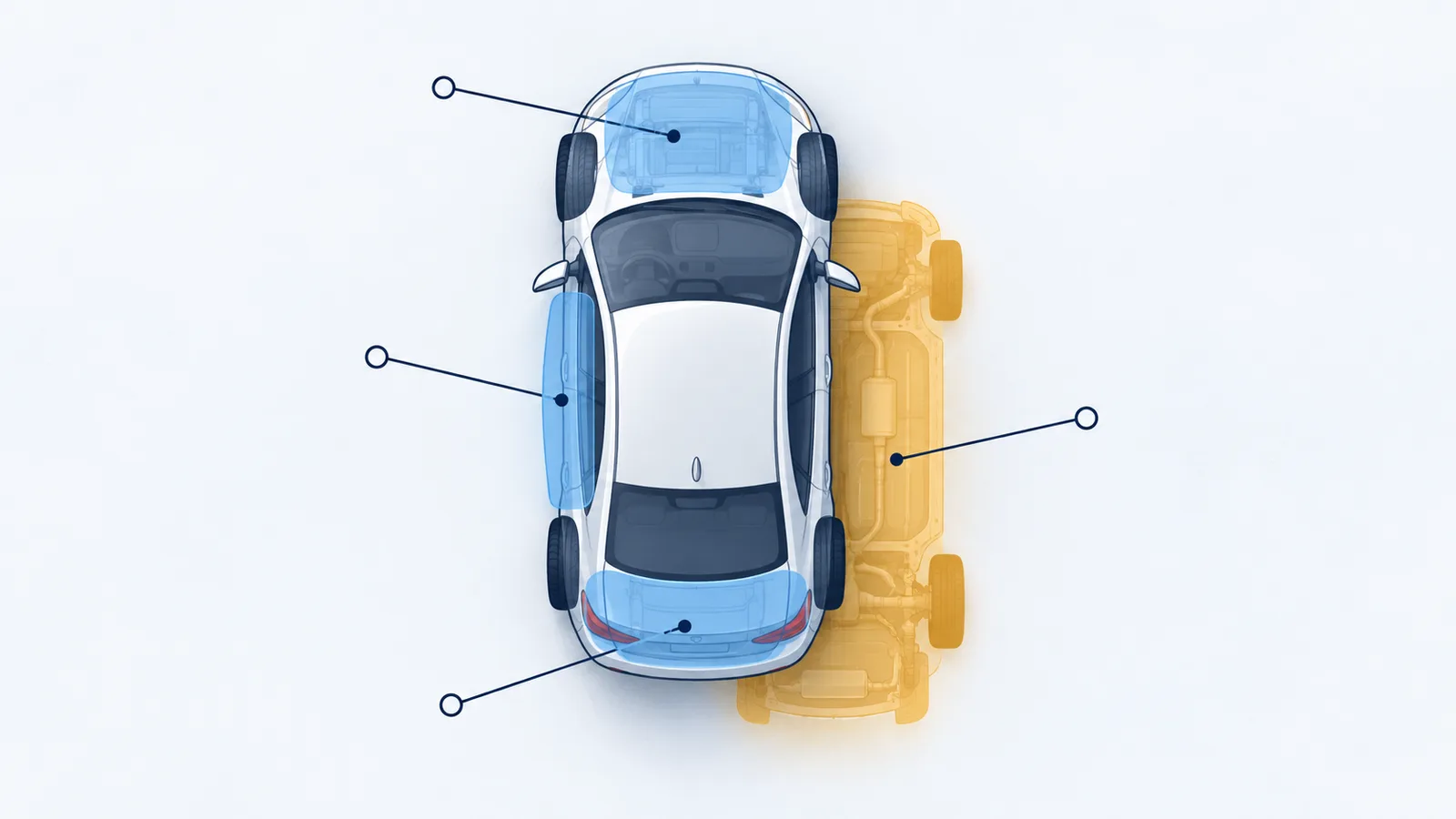
There is no shortage of damage-code glossaries online: "Front End — the front", "Rear End — the back". The problem is that for a dealer this is the least useful part of the information. You can already see from the photos where it was hit.
The questions a glossary does not answer: which codes mean a cheap repair and which mean a write-off; what to do with the Primary/Secondary pair; and how far these codes can be trusted at all. That is what follows.
Primary and Secondary Damage: why there are two
Each lot carries up to two codes: Primary Damage, the main recorded damage, and Secondary Damage, the additional one. The most common beginner mistake is reading the second as "minor, safe to ignore".
The order actually reflects what the insurer considered the primary cause, not the scale. A car listed Primary: Front End with Secondary: Undercarriage is probably a far worse story than Primary: Front End alone — because the second code says the impact reached the floor of the car.
How far the codes can be trusted
There is a caveat few people say out loud, though Copart states it plainly itself: the codes reflect only known or recorded damage, they are limited in nature, and the platform expressly disclaims responsibility for their accuracy — what is listed may not reflect the actual type or extent of the damage.
The practical takeaway is that a code is a screening filter, not a basis for a decision. It exists so you can reject a lot or shortlist it in a second. The decision comes from photos, the history report and the arithmetic — not from two words in a listing.
Codes ranked by margin risk
A practical classification — not by geometry, but by how predictably the repair can be costed.
Predictable: body work with a knowable estimate
| Code | What it is | Why it is predictable |
|---|---|---|
| Front End | Front: bumper, lights, radiator, hood | The most common code at auction. Parts available, estimate calculable |
| Rear End | Rear: bumper, tailgate, lights | Usually cheaper than the front — fewer assemblies involved |
| Side / Left / Right | Side impact: doors, fender, sill | Risk sits in pillars and airbags; on its own it costs out reasonably |
| Minor Dent/Scratches | Small dents and scratches | The cheapest category. Often a lot written off for a different reason |
| Hail | Hail damage | Panels dimpled, mechanicals untouched. Frequently a very profitable category |
| Vandalism | Vandalism | Variable, but usually no structural damage |
Risky: the estimate can double once it is apart
| Code | What it is | Where the risk sits |
|---|---|---|
| All Over | Damage across the whole body | The broadest and least informative code. Can mean almost anything |
| Undercarriage | Floor, suspension, lower structure | Body geometry. The most expensive kind of hidden repair |
| Rollover | Rolled | Roof, pillars and all geometry at once, plus near-certain airbag deployment |
| Mechanical | Drivetrain failure with no exterior damage | An intact-looking car. Engine or transmission can cost half the lot |
| Electrical | Electrical fault | Long diagnosis; the cause can be anywhere |
| Normal Wear | Wear with no specific incident | Often means high mileage and accumulated problems |
Categories that deserve extra attention
| Code | What it is | Why it is its own category |
|---|---|---|
| Water / Flood | Water damage | Electronics and corrosion surface over months. Often paired with its own title brand |
| Burn / Burn Engine / Burn Interior | Fire | Wiring and plastics affected throughout, even when the fire was local |
| Stripped | Vehicle stripped of parts | Value depends on exactly what is missing — and nobody made a list |
| Biohazard / Chemical | Biological or chemical contamination | The interior is often cheaper to replace than to clean |
Water/Flood deserves its own conversation
The most treacherous category, because a flooded car can photograph perfectly. The water recedes, the silt washes out, the interior dries — and from the outside it is a clean lot at an attractive price.
The problems arrive months later: corroded contacts, electronic faults, a smell that never leaves. They cannot be fixed systematically because they surface one at a time. This is the case where a cheap lot becomes an endless lot.
So flood gets checked twice: the lot code plus the title brand — many states assign a separate Flood brand, which will also appear in the VIN history report. If the code says water and the title is clean, that is a reason to look harder, not to celebrate.
See which title a lot carries and whether it has a water brand — by lot number or VIN, free.
Check the titleHow to read damage on an actual lot
- 1Read both codes as a pair — where it was hit and where the force went next.
- 2Check whether the airbags deployed. It is a field on the lot and visible in photos. Deployed airbags mean thousands of dollars and almost always a question about geometry.
- 3Compare the code against the photos. A mismatch is itself important information: there is either more damage than recorded, or less.
- 4Check whether it runs (Run and Drive / Starts). Not a guarantee, but a Mechanical code without that flag is a different level of risk.
- 5Verify the build — the window sticker by VIN shows what left the factory on the car; the photos show what survived.
- 6Read the history — a VIN report tells you whether this is the car's first serious damage.
- 7Price the whole thing — auction fees, logistics, duties, and only then the repair.
The main mistake here is costing the repair first. Repair is the last variable: if landed cost before repair already leaves no room for margin, the damage type stopped mattering some time ago.
NotedCar shows damage, title, history and landed cost on one card — and works out the maximum bid that protects your margin.
Start 14 days free