
MV-907A title check: how to look up a New York salvage certificate and liens on the DMV site
What an MV-907A salvage certificate is, why to check it on the New York DMV site before bidding, what to enter (VIN, model year, the make abbreviation), how to read the result and the MV-913 report — step by step, with screenshots.
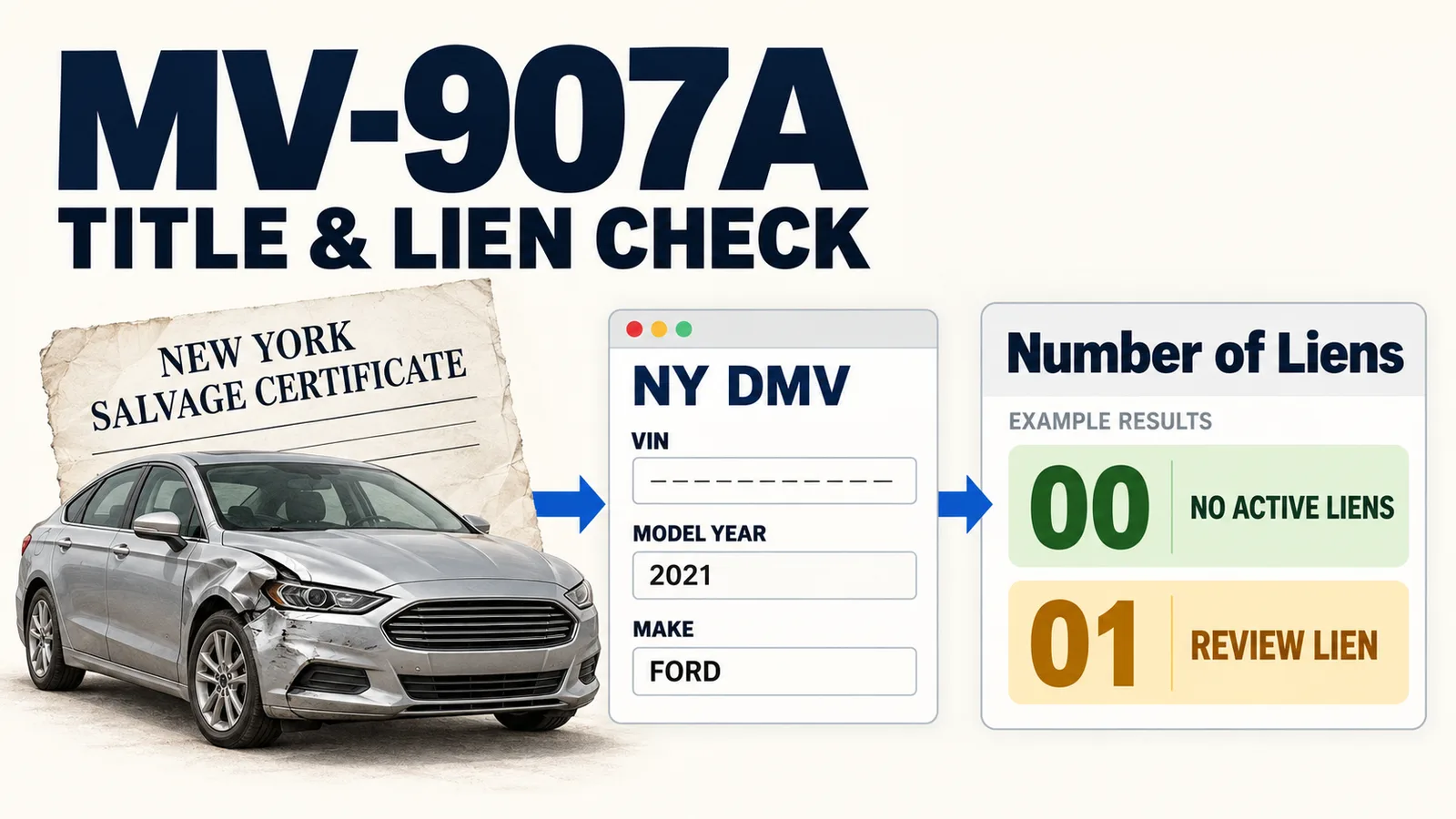
MV-907A is the New York State Salvage Certificate: the document the DMV issues in place of a title once an insurer has declared the car a total loss. On Copart and IAAI it appears as “NY - MV-907A SALVAGE CERTIFICATE” or “Mv-907A (New York)”, and in our data it is one in three lots from the state — around three thousand cars a month.
The New York DMV runs a free Check Title or Lien Status page that, given a VIN, shows whether the car carries an active lien and when the document was printed. This article is a step-by-step guide to using it, and to what the result means for a buyer abroad.
What MV-907A is
After a total loss the insurer surrenders the title to the DMV and receives an MV-907A certificate instead. It proves ownership but does not allow the car to be registered in New York until it has been repaired and passed the state’s salvage examination. That is why these lots sell cheap: inside the state the only buyer is someone ready for the inspection, while for an exporter it is an ordinary ownership document that the port accepts.
US document types in general are covered in the guide to US car titles, and the difference between Salvage and Rebuilt in Salvage vs Rebuilt. This piece is about the one thing an MV-907A deserves a separate check for.
Why check it on the DMV site
An MV-907A certificate can come with a tail. In the auction’s Title line it shows up in these variants:
| Line on the lot | What it means | Risk |
|---|---|---|
| NY - MV-907A SALVAGE CERTIFICATE / Mv-907A (New York) | The ordinary certificate after a total loss | Low |
| NY - MV907A W/UNSATISFIED LIEN | A lender’s lien on the car has not been released | High |
| NY - MV-907A OPEN LIEN / GARAGEMAN’S LIEN | An open lien, or a repair shop’s or storage lien | High |
| NY - MV907A-PARTS ONLY | Parts only, cannot be rebuilt | High |
| NY - MV907A-FLOOD SALVAGE | The same certificate; the damage is flood | Depends on the car |
| NY - MV907A WITH ALTERED VIN / NO PUBLIC VIN | Problems identifying the body | High |
The problem is that the auction copies the line from the document when the car is checked in, while a lien is a record in the DMV database that can appear, be released or be missed. The DMV lookup shows the current state of the record: how many active liens are on the VIN and who the lienholder is. It is free, needs no account and takes a minute.
What you need for the check
- The car’s VIN — the 17 characters from the lot page. If the auction masks the VIN with asterisks, open the lot through the free lot report or ask your broker for the full VIN.
- The model year — four digits, as on the lot.
- The make abbreviation the way the New York DMV writes it — up to five letters. There is a section on that below.
The form lives at process.dmv.ny.gov/TitleStatus/Index (the short link printed on DMV reports is dmv.ny.gov/titlestat). No registration, captcha or payment. The DMV shows no personal data about the owner, so checking someone else’s car before bidding is both legal and normal.
Step by step
- 1Open the Check Title or Lien Status page on the New York DMV site.
- 2Under Vehicle Type leave Vehicle / Manufactured Home selected (the Boat option is for boats).
- 3In Vehicle / Hull Identification Number (VIN / HIN) enter the VIN. The DMV’s own hint: if a character looks like the letter I, enter the digit 1; if it looks like O, enter zero — a VIN never contains either. Length can be 11 to 17 characters; older cars have shorter numbers.
- 4In 4-Digit Model Year enter the model year as four digits.
- 5In Make enter the make abbreviation — at most five letters (for example GMC, SAAB, CHEVR), or four letters separated by a slash for compound names (HA/DA for Harley-Davidson, ME/BE for Mercedes-Benz).
- 6Click Continue.
Opens in a new tab on process.dmv.ny.gov — the official New York State site, free and without registration.
Open the DMV lookup form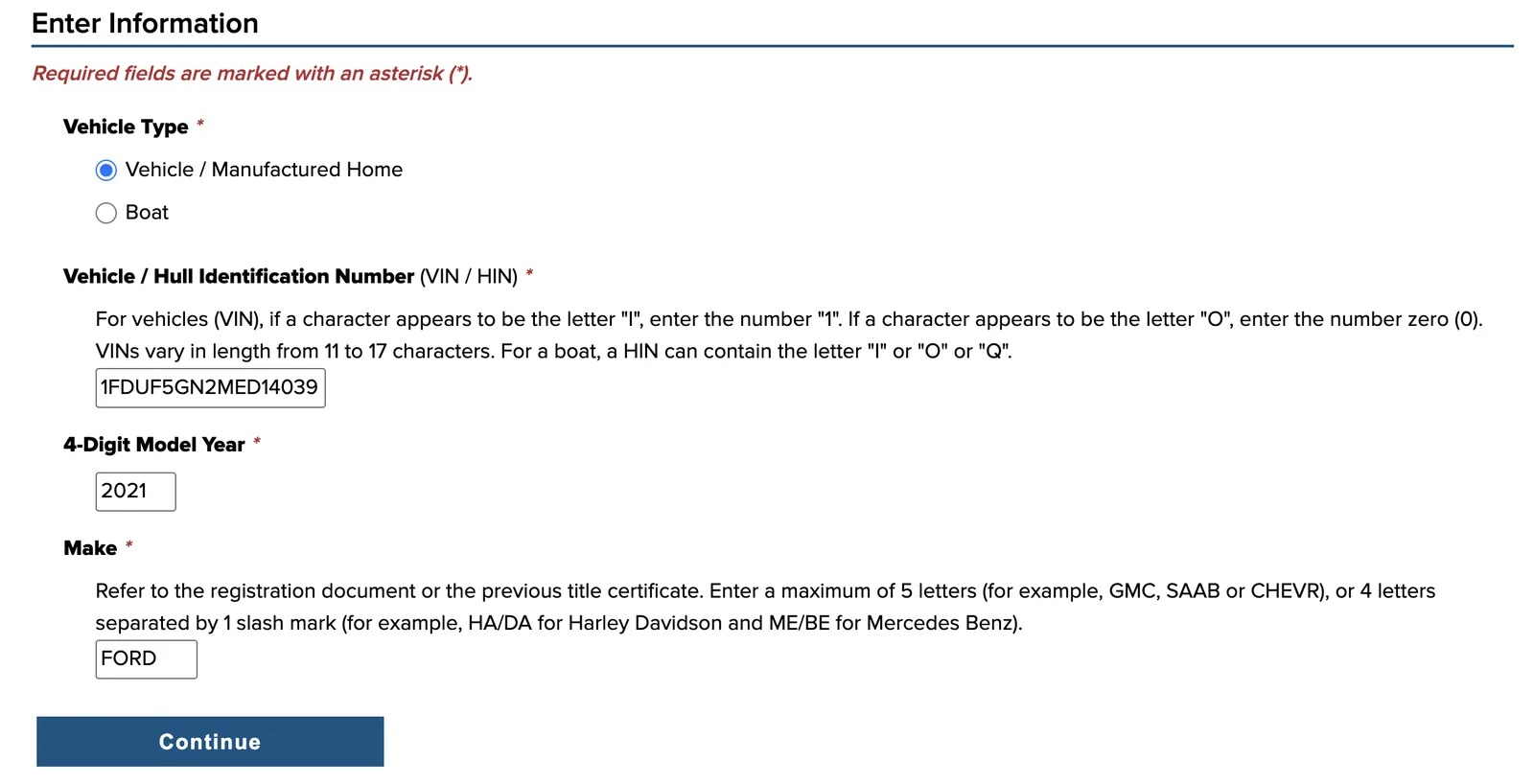
How the DMV abbreviates the make
The DMV takes the make from the registration document as a code of up to five letters. The examples on the form itself are GMC, SAAB, CHEVR, HA/DA and ME/BE. For every other make the same rule applies — the first five letters of the name:
| Make | Code for the Make field |
|---|---|
| Ford, Jeep, Dodge, Audi, Mazda, Tesla, Lexus, Acura, Kia, Ram | The full name when it is 5 letters or fewer: FORD, JEEP, AUDI, TESLA |
| Chevrolet | CHEVR (an example from the DMV form) |
| Toyota, Honda, Nissan, Hyundai, Subaru, Porsche, Volkswagen | The first five letters: TOYOT, HONDA, NISSA, HYUND, SUBAR, PORSC, VOLKS |
| Mercedes-Benz | ME/BE (an example from the DMV form) |
| Harley-Davidson | HA/DA (an example from the DMV form) |
Reading the result
After Continue the DMV shows “Your search returned 1 result of 1 found” and a block headed Your Title or Lien Status Information:
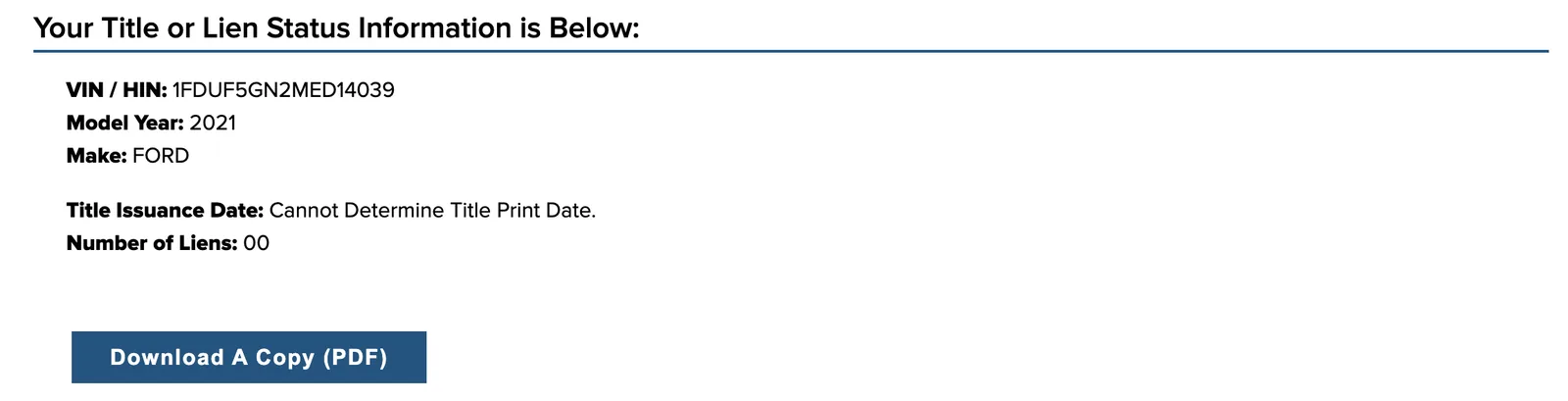
| Field | What it means |
|---|---|
| VIN / HIN, Model Year, Make | The car that was found. Compare with the lot — if it does not match, go back and check what you entered. |
| Title Issuance Date | The date the DMV printed the current document. Cannot Determine Title Print Date is common on salvage records: the document exists, but the electronic record carries no print date. On its own that is not a problem. |
| Number of Liens | The field that matters. 00 means no active lien. Any other number, and the lienholder’s name and address appear below. |
If liens read 00 while the lot says W/UNSATISFIED LIEN, the lien was most likely released after the auction checked the car in and the line simply stayed. If there is a lien and the lot says nothing about it, you have just saved yourself a few thousand dollars.
The MV-913 report as a PDF
The Download A Copy (PDF) button under the result produces an official document — the Title or Lien Status Report, form MV-913 — with the date and time of the query, the state seal and the same set of fields. In it the DMV states plainly that only active liens are shown, and that any lien printed on a paper MV-999 title issued before the report date has been released electronically.
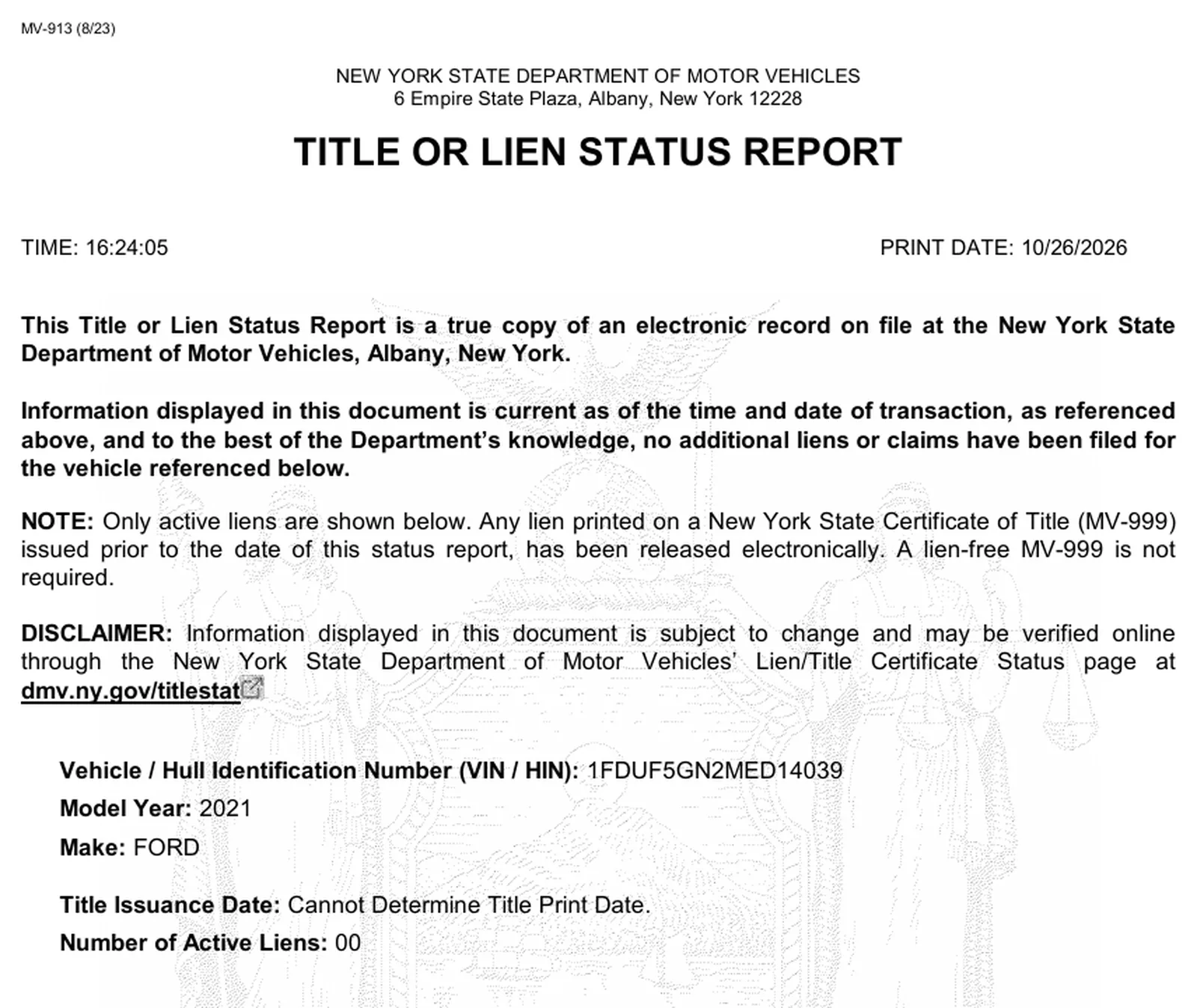
Save this PDF to the lot’s folder. If a lien appears later or the port raises a question, you hold an official time-stamped document showing the record was clean when you bid.
What the check does not show
- Damage and the car’s condition. Only the document record and liens. For accident history see a Carfax report.
- Other states’ records. If the car once had a New Jersey or Florida title, it is not here — that is what NMVTIS and history reports are for.
- Whether your country accepts the document. That is a question for customs and the registration office at the destination, not for the New York DMV.
- Whether the car will pass New York’s salvage examination. Irrelevant for an exporter, decisive for a buyer in the US.
What to do after the check
- 1Liens 00 and an ordinary MV-907A line on the lot: the document is no obstacle to bidding. Move on to checking the car, not the paperwork.
- 2There is a lien: either walk away or price in a lien release and the time it takes. For a buyer abroad the first option is almost always the right one.
- 3A PARTS ONLY or ALTERED VIN line: the lien is beside the point, this lot is not for registration — see the guide to the Certificate of Destruction.
- 4Keep the MV-913 together with a screenshot of the lot — it is your evidence in any dispute with a broker or the port.
To see quickly which MV-907A variant a lot carries, run the free title check by lot number or VIN: it recognises the auction’s line, says whether the document can be exported and what a conversion typically costs.
Found a lot on Copart or IAAI? Open the free lot report — every photo, the title with its export verdict, the damage and this VIN's sale history. All it takes is a free account.
Open the lot report