
Importing a US car to Georgia in 2026: the 1.5 and 4.5 GEL excise, import tax and worked examples
How customs clearance of a US auction car works in Georgia after the 2 April 2026 changes: excise of 1.5 GEL per cm³ up to six years old and 4.5 GEL beyond, the 0.05 GEL per cm³ import tax, the hybrid discount, transit through Poti and worked examples.
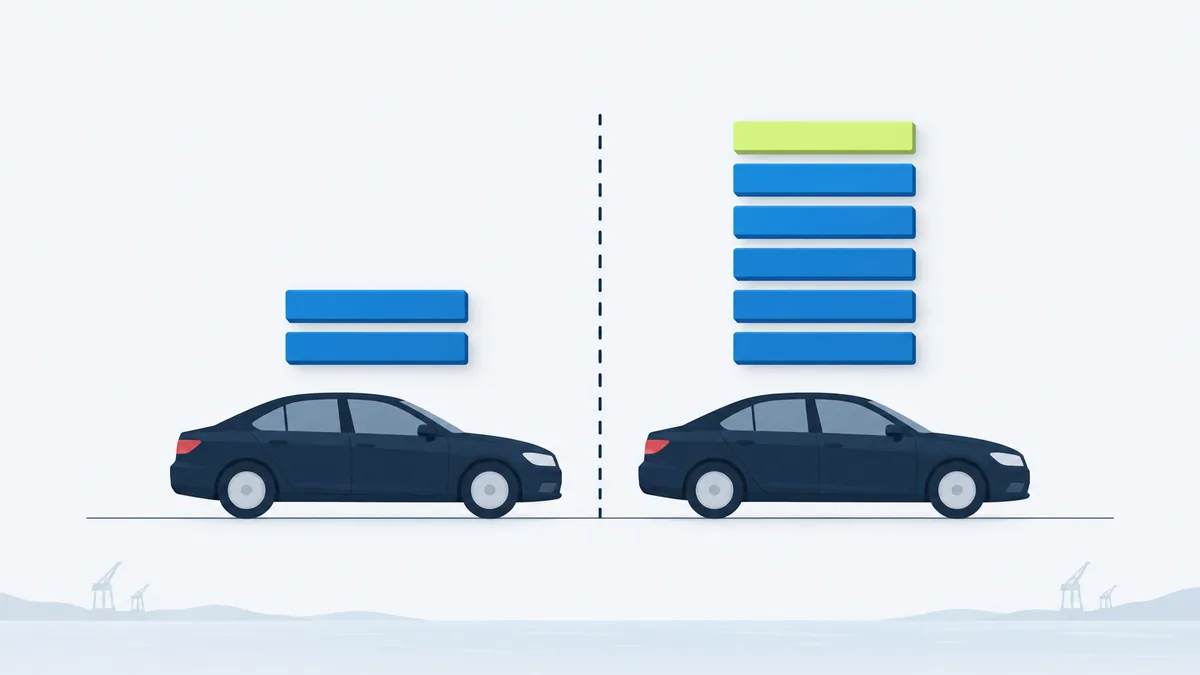
Georgia was for years the cheapest place in the region to clear a US car. Since 2 April 2026 that holds only for cars up to six years old: beyond that the excise rose to 4.5 GEL per cubic centimetre, and the arithmetic of a lot changed completely.
Below: what the bill consists of, how to work it out before bidding, and why the model year now gets checked before the damage.
What clearance in Georgia consists of
| Charge | How it is calculated | Driven by |
|---|---|---|
| Excise | 1.5 GEL per cm³ up to 6 years old; 4.5 GEL per cm³ beyond | Engine size and age |
| Import tax | 0.05 GEL per cm³ + 5% of that amount per year of age | Engine size and age |
| VAT | Not charged: import of passenger cars is VAT-exempt | — |
| Clearance fees | Fixed amounts: customs service, appraisal, declaration, registration | Independent of the car’s price |
Excise: six years is the line
Before April 2026 excise rates ranged from 0.8 to 2.4 GEL per cm³. Now there are two, and one is three times the other:
| Category | Excise rate |
|---|---|
| Car up to 6 years old | 1.5 GEL per cm³ |
| Car older than 6 years | 4.5 GEL per cm³ |
| Hybrid up to 6 years (left-hand drive) | 40% of the rate, i.e. 0.6 GEL per cm³ |
| Electric vehicle | The displacement excise does not apply |
| Right-hand drive | Rate × 3 |
The hybrid discount stops at six years: an older hybrid pays the full 4.5 GEL. That is why the 2018 Toyota Prius example quoted in the Georgian press shows excise rising from 1,440 to 8,100 GEL.
Example: the same Camry, a different year
Toyota Camry 2.5 (2,487 cm³), cleared in 2026.
| 2021 (5 years) | 2019 (7 years) | 2021 hybrid | |
|---|---|---|---|
| Excise | 2,487 × 1.5 = 3,731 GEL | 2,487 × 4.5 = 11,192 GEL | 3,731 × 0.4 = 1,492 GEL |
| Import tax | 124 × 1.25 = 155 GEL | 124 × 1.35 = 168 GEL | 155 GEL |
| Total | ≈ 3,886 GEL | ≈ 11,360 GEL | ≈ 1,647 GEL |
Two years of age cost about $2,800 here — more than the gap between those cars at auction. So the model year is now checked first: a car that turns six while the container is at sea should be priced at the higher rate from the start.
Transit and re-export through Poti
A large share of the cars landing in Poti travel on — to Armenia, Azerbaijan, Kazakhstan. Excise is a tax on release into free circulation in Georgia: a car in transit, or one held in the Poti free industrial zone for onward shipment, does not pay it.
For a dealer that means two different calculations: for a client in Georgia, the table above; for a client in a third country, delivery to Poti plus the destination’s own rules. Those are covered separately for Kazakhstan, Kyrgyzstan and Uzbekistan.
What this changes in your bid
- Age is the first filter. For a client in Georgia, lots older than six years only work with a small engine or a very low price.
- Engine size is the second. 1.5 L versus 3.0 L on an older car is 6,750 versus 13,500 GEL of excise.
- Hybrids up to six years are the cheapest category to clear: 0.6 GEL per cm³.
- The car’s price does not move the customs bill. A dearer but younger lot is often cheaper landed.
- Auction fees are a separate line — get the exact amount from a lot number, and check the title before you bid.
Price the Copart and IAAI fees from a lot number and check whether a car with that title can be exported — free, no account needed.
Calculate auction fees