
Salvage vs Rebuilt title: the difference and what it does to the price

How a Salvage Title differs from a Rebuilt Title: what each one means, how a car moves from one to the other, how much they cut the price, and what matters for a buyer importing the car from the US.
·3 min read
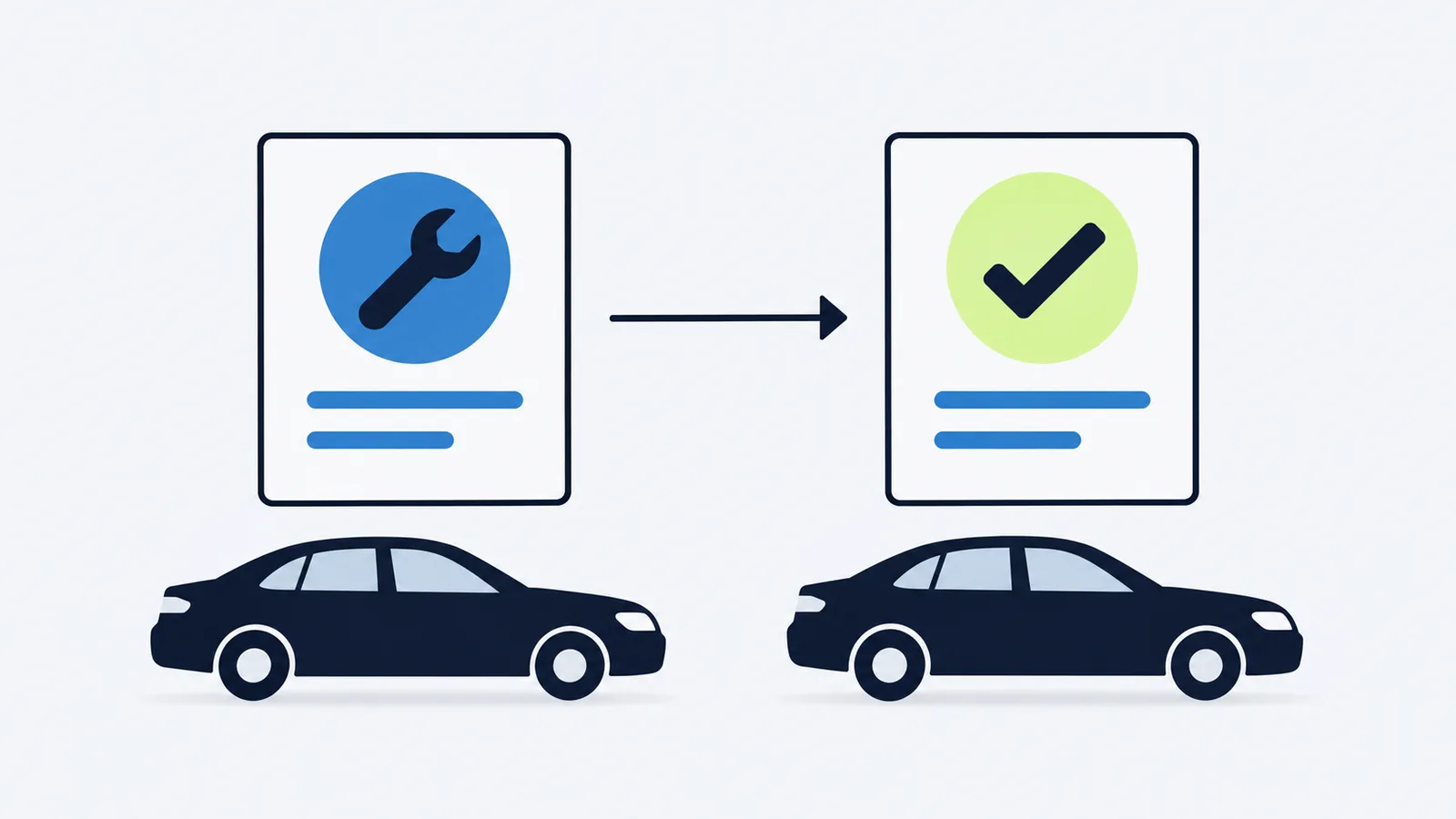
Two identical cars below documents with repair and inspection symbols connected by an arrow

The short answer: a Salvage Title means an insurer declared the car a total loss; a Rebuilt Title means that car was then repaired and passed a state inspection. They are two stages in the life of one vehicle, not two kinds of vehicle.

For an auction buyer the difference is practical: Salvage is bought to be rebuilt; Rebuilt has already been rebuilt by someone else. What follows is what that means for price, risk and import.

What a Salvage Title is

An insurer pays the owner out and takes the car when the repair cost exceeds a set share of its market value. The threshold is set by the state — usually somewhere between 70% and 100%, with some states using a formula. The state then issues a Salvage Title.

Two consequences. First: a Salvage Title car cannot be registered or driven on US roads until it is repaired and inspected. Second: salvage is a financial decision, not a technical one. A cheap car is written off over a bumper and headlights; an expensive one is repaired after a serious hit. The damage code tells you about severity — the title does not.

What a Rebuilt Title is

A Salvage Title car has been repaired and passed a state inspection: a check that the repair was done and the parts used were not stolen. The state issues a new document — Rebuilt (in some states Reconstructed or Prior Salvage). With it the car can be registered, insured and sold again.

Side by side

Salvage TitleRebuilt Title
What it meansWritten off by an insurer, not repairedRepaired after Salvage, passed inspection
Can be driven in the USNoYes
Who does the repairYouThe previous owner
Price versus CleanMuch lowerUsually 20–40% lower
Main riskHidden damage, repair costThe quality of someone else’s repair
Who buys itDealers and rebuildersEnd buyers who want a discount

What they do to the price

A Rebuilt Title usually cuts the market price by 20–40% against the same car with a Clean Title — depending on the type of damage, the repair documentation and the model. Salvage sells for less still, because the buyer takes on the repair and the uncertainty. How to value a specific car is in the guide to how much a Rebuilt Title cuts a car’s value.

At auction that means the price of a Salvage lot has to be worked backwards from the Rebuilt price, not the Clean price: Rebuilt is what the market will pay you after the repair.

What it means for an importer

  • Export. Both Salvage and Rebuilt cars leave the US freely. The restrictions apply to other documents — Junk and the Certificate of Destruction.
  • Customs. For Ukraine the title type does not change the rates: duty, excise and VAT are the same. A damaged car has a lower customs value, and that is the only thing that moves the bill. See the customs calculator.
  • The history follows the VIN. A local registration document carries no US title brand, but Carfax and the auction photos are available to anyone by VIN. A buyer who checks will see Salvage — price that into the resale.
  • Rebuilt from an auction is a special case. A car that was already rebuilt and is back at auction has often been repaired twice. The history in a Carfax report is not optional.

What to check before bidding

  1. 1Title type and state — a title check by lot number or VIN.
  2. 2Damage code and photos — an estimate of the actual repair, not of the brand.
  3. 3History — previous write-offs, owner count, whether the mileage adds up.
  4. 4Every title brand together — in the guide to US car titles.

NotedCar shows the title type and its risk on every lot before you bid, and works the maximum bid back from the real resale price.

Start 14 days free

Frequently asked questions

Keep reading

How Copart works: buying a car as a foreign buyer

Who is allowed to bid at Copart, how much you need on deposit before the first bid, and where a broker fits. The auction’s mechanics from sign-up to a won lot.

EV customs in Ukraine in 2026: 20% VAT, €1 per kWh excise and worked examples

The VAT exemption ended on 1 January 2026. An electric car now costs a little over 20% of its value to clear — here is the formula and the numbers.

Copart and IAAI glossary: lot page terms and how to read the invoice

Every flag on a lot page means less than it sounds like. Here is what each one actually records — and what it does not promise.

Certifying a US car in Ukraine: first registration and the 2026 rules

A cleared car still cannot be registered. Between customs and plates sit certification, a lighting conversion and the pension fund fee.

Certificate of Destruction: what it means and whether the car can be exported

The cheapest lots at auction often carry this document. Legally it is no longer a vehicle but a set of parts — and that changes everything.

After winning a Copart lot: payment deadline, storage, late fees and relist

The clock starts when the hammer falls. Three business days to pay, then a late fee, then storage every day — and eventually your lot is sold again at your expense.

How much a Rebuilt Title cuts a car’s value: how to estimate it and set your bid

The 20–40% rule is only the start. The real discount depends on the damage type, the paperwork and the model — and it decides how much you can pay for the lot.

How to track a car shipped from the US: stages, numbers and where to check

There is no single “track by VIN”: every leg of the journey has its own number and its own place to look. Here is the map of the whole route.

Importing a US car to Georgia in 2026: the 1.5 and 4.5 GEL excise, import tax and worked examples

Since April 2026 a car’s age matters more than its price in Georgia: the seventh year triples the excise. The formula, examples and what it does to your bid.

Importing a US car to Kazakhstan in 2026: 15% duty, 16% VAT, the recycling fee and the 500 MRP registration

In Kazakhstan the biggest charge is not duty but first registration: 500 MRP for a car over three years old. Here is how that changes which lot you pick.

Importing a US car to Kyrgyzstan in 2026: the EAEU flat rates in euro per cm³, with examples

In Kyrgyzstan the bill is computed from cubic centimetres, not price — and a car’s fifth year doubles the rate. The full table and three examples.

Importing a US car to Uzbekistan in 2026: 40% + $3 per cm³ duty, and why to run the numbers first

On a car over three years old, duty alone in Uzbekistan exceeds the price of the car. Here is the formula and the categories where importing still works.

Copart and IAAI fees in 2026: every buyer charge and how to price a lot properly

Your bid is roughly 75–85% of what you actually pay the auction. Here is every Copart and IAAI charge, what moves it, and how to price a lot before you bid.

Landed cost of a US car: from the auction bid to customs clearance

The auction bid is roughly half of what you will pay. Here is the other half — and how to work your maximum bid backwards from the margin you need.

Pure Sale, On Approval and Seller's Reserve: Copart and IAAI sale statuses explained

Winning the auction and buying the car are not the same thing. Here is what every Copart and IAAI sale status means for your bid.

US car titles explained: Clean, Salvage, Rebuilt and Junk — and what can actually be exported

The title is the document that decides everything: whether the car leaves the country, whether it clears customs, and what the deal really costs.

Copart and IAAI damage codes: which ones actually destroy your margin

Translating a damage code is easy. Knowing which ones cost a hundred dollars and which close the deal before you bid is the part that matters.

How to check a US car's history by VIN: Carfax, AutoCheck and their blind spots

A VIN report is the cheapest way to avoid buying someone else's problem. But its limits deserve as much attention as its contents.

Window sticker by VIN: how to check factory equipment on a US car

An auction listing gives you three lines. The factory sticker tells you exactly how the car left the line and what it cost when new.

Price the whole lot before you bid

NotedCar rolls auction fees, logistics and customs into one number, flags the sale type and title risk, and keeps every client in one place.