
US car titles explained: Clean, Salvage, Rebuilt and Junk — and what can actually be exported
A breakdown of US auction car titles: Clean, Salvage, Rebuilt, Junk, Certificate of Destruction and Bill of Sale. Which titles can be exported and registered, and which ones turn a cheap lot into frozen capital.
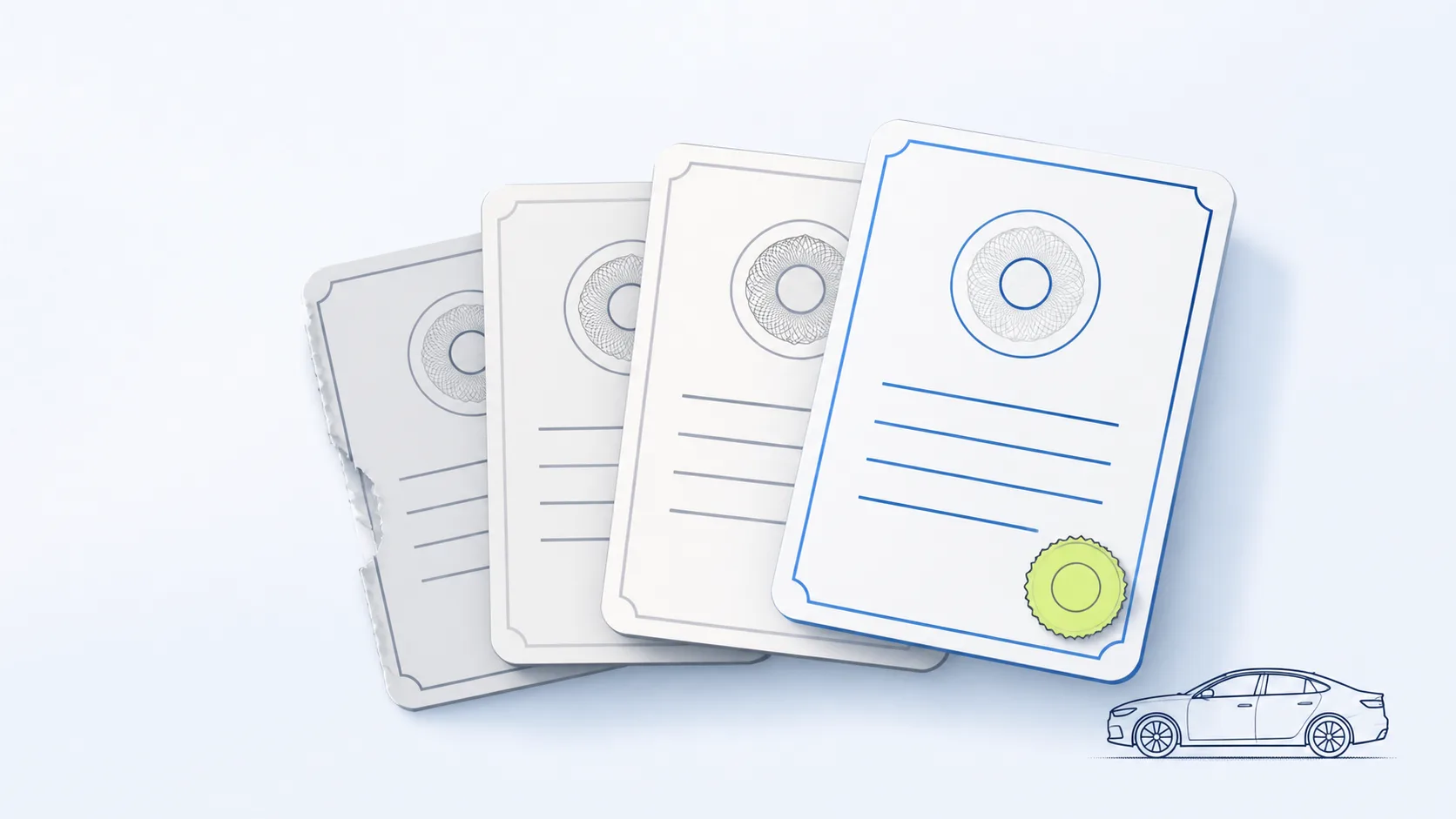
A title is the certificate of ownership for a vehicle in the US and Canada. For a dealer it is not paperwork — it is the first thing to look at on a lot: the title type decides whether the car can leave the country at all, how long the documents take, and whether it will clear customs at the destination.
A mistake here costs more than any fee miscalculation. A misjudged fee is a few hundred dollars. A won lot with a title that cannot be exported is frozen capital and a car that goes nowhere.
What a title is and why it outranks everything else
A title carries the VIN, the owner and — critically — a brand: a state-assigned mark describing the vehicle's status. The brand is what turns an ordinary ownership certificate into a document that constrains the car's future.
A detail that is regularly missed: brands are assigned by states, and states use different thresholds. The same car can be branded Salvage in one state and stay Clean in another. "Title from state X" is therefore not geography — it is a different rulebook. A car whose title was re-issued in another state can look cleaner than it is.
The main title types
| Type | What it means | Export | Typical situation |
|---|---|---|---|
| Clean Title | Never declared a total loss | Unrestricted | Ordinary sale, repossession, rental fleet |
| Salvage Title | Declared a total loss by an insurer | Allowed | The most common title at Copart and IAAI |
| Rebuilt / Reconstructed | Repaired after salvage, passed state inspection | Allowed | Already repaired and inspected |
| Junk / Non-Repairable | Parts only, cannot be rebuilt | Restricted or prohibited | The riskiest category for a dealer |
| Certificate of Destruction | Certificate of destruction | Prohibited | Legally no longer a vehicle |
| Bill of Sale | Sale contract with no title | Depends on the state | Common on old or very cheap lots |
| Flood / Water Damage | Water damage | Allowed | A separate brand, often alongside salvage |
| Lemon / Manufacturer Buyback | Bought back by the manufacturer over a defect | Allowed | Less common |
Clean Title
The car was never declared a total loss. That does not mean "undamaged": a Clean lot can reach the auction after a minor accident, a repossession, or the end of a rental or lease term. Clean titles mean the simplest paperwork and the highest resale — and the strongest bidding competition.
The trap: a Clean Title does not guarantee a clean history. Damage that an insurer paid out without writing the car off never appears in the brand. So a Clean lot still deserves a Carfax report, which is where accidents, odometer changes and owner counts actually show up.
Salvage Title
An insurer declared the vehicle a total loss: repair cost exceeded a threshold share of market value. This is the most common title at Copart and IAAI and the default scenario for a dealer importing cars to rebuild.
What matters is that salvage is a financial decision, not a technical one. A nearly intact cheap car can be totalled, while a badly damaged premium car may still be worth repairing. Judge the photos, the damage description and the valuation — not the brand.
Rebuilt / Reconstructed Title
A salvage vehicle that was repaired and passed a state inspection, meaning it is certified roadworthy again. For a dealer it is a compromise: cheaper than Clean, less risk than Salvage — but the repair was done by someone you do not know, to a standard you cannot verify. Quality varies enormously.
Junk / Non-Repairable Title
The vehicle is officially designated for parts only and cannot be rebuilt or registered. This is the most dangerous category for an inexperienced buyer: the lot photographs like an ordinary car and carries an attractive price, but legally it is no longer a vehicle.
Bill of Sale
Not a title but a sale contract, used where a title was never issued or is no longer required under state law — typically for very old or very low-value cars. Processing is more involved and requires checking the specific state's and the destination customs' requirements separately.
What can be imported into Ukraine
The general logic: the car has to remain a vehicle in the legal sense. Salvage and Rebuilt titles are imported into Ukraine at volume without structural problems — they are the backbone of the US-import market. Difficulty starts where the document states the vehicle no longer exists as such.
- Salvage and Rebuilt — the standard scenario; the brand itself imposes no restriction.
- Clean — the simplest case on paperwork.
- Junk, Non-Repairable, Certificate of Destruction — require separate verification; export and clearance are not guaranteed.
- Bill of Sale — handling depends on the state; budget extra time.
Separately from the title brand, general import restrictions apply: vehicles originating in, or imported from, an aggressor state or the occupied territories of Ukraine cannot be cleared. That is checked independently of the document brand.
Customs is calculated identically for every title type: 10% import duty on customs value + excise (base rate × engine displacement ÷ 1000 × vehicle age, capped at 15 years) + 20% VAT on the total of value, duty and excise. The title brand does not change the rate — it changes the customs value, since a damaged car is valued lower, which reduces the payment when declared correctly.
How to check a title before bidding
The sequence that should become automatic:
- 1Read the title type and issuing state — a free title check by lot number or VIN shows the title, whether it can be exported, and roughly what re-issuing the document costs.
- 2Match the car to the document — decode the VIN to confirm make, model, year, engine and build.
- 3Read the history — a Carfax report surfaces accidents, mileage and owners that the title brand never shows. What a report covers, and what it structurally cannot, is in the guide to checking history by VIN.
- 4Price the deal — auction fees plus logistics and duties, with time for document processing built in.
The whole sequence takes about a minute per lot. Against the weeks a wrong-title lot costs, it is the cheapest check in the entire process.
Titles are a schedule problem, not just a risk problem
The document travels separately from the car and does not always travel faster. Title delays are one of the most common reasons a vehicle sits in port with the storage meter running. Re-issuing a lost or damaged title can take weeks, and none of that time is under your control.
For a dealer running several deals at once that means one thing: title status has to be a visible field on every deal, not a line in a chat thread with a broker.
NotedCar flags the title type and its risks on every lot before you bid, then tracks the documents and logistics inside the deal after you win.
Start 14 days free