
Copart and IAAI lots that sell below market: what 144,000 sales show

One lot in ten sells at 65% of its modelled price or less. We modelled 143,989 US sales and found which pre-sale signals raise that share: listing age, sale type, seller, yard state, weekday and damage labels.
·6 min read
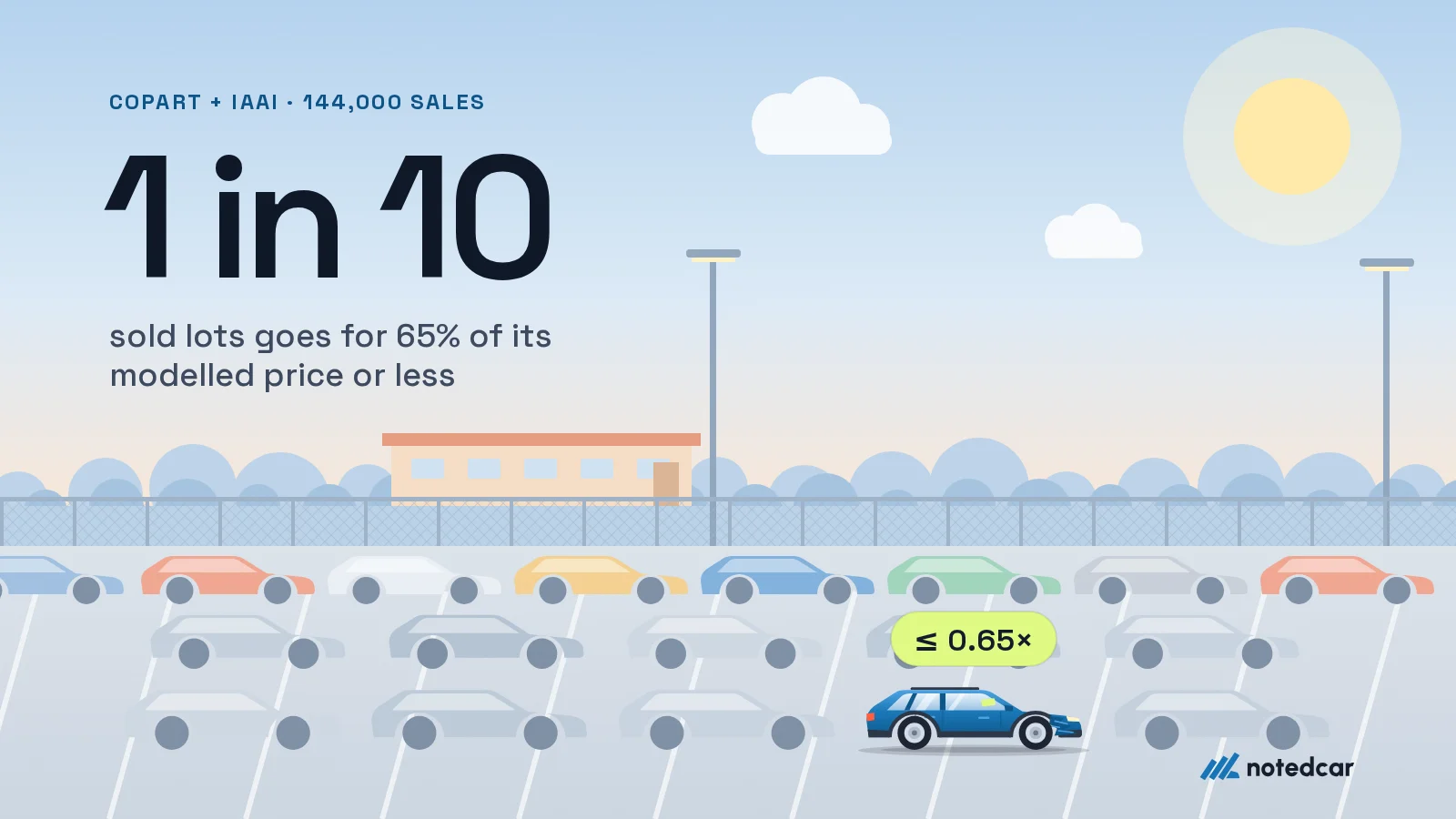
An auction yard with ten cars: nine grey and one blue crossover marked “≤ 0.65×”. One sold lot in ten at Copart and IAAI goes for 65% of its modelled price or less.

One sold lot in ten at Copart and IAAI goes for 65% of its modelled price or less. We modelled 143,989 US sales from six weeks and looked at which pre-sale signals predict that outcome: the numbers, two tables and a checklist.

The question and the baseline

For every sold car the model estimates what it should have fetched given make, model, year, trim, odometer, damage, title, run status, keys, airbags and site. A "deal" is a sale in the bottom decile of the residual, i.e. at no more than 0.65x the modelled price. By definition that is 10% of sales. The question is which listing signals raise that share.

SignalSalesPrice vs modelDeal rate
IAAI live auction, listed 21+ days2,7740.86x23%
IAAI live auction, listed 28+ days1,5070.84x26%
IAAI, listed 21+ days, dealer seller1,1960.78x31%
NE/WV/AL/MI/OH yard, IAAI auction, listed 14+ days8140.82x28%
Car 10+ years old, live auction, dealer seller10,1580.94x20%
Copart, listed 10–35 days7,5370.99x15%
Buy Now (either site)20,7671.08x4%
Timed (IAAI)6,0411.05x5%
Classifier, top 5% of score (AUC 0.73)7,2000.83x30%
Pre-sale signals: median price vs the model and deal rate (baseline 10%)

Try the calculation yourself

Change the bid and see delivery, fees, and customs in a working demo. No registration needed.

No sign-up. Explore the example without saving changes.

Listing age: the strongest lever

Price falls steadily after about 10 days on site. The effect is clearest at IAAI: live-auction lots listed 21 days or longer closed at a median 0.86x the modelled price, and 23% were deals. From 28 days, 0.84x and 26%. With a dealer seller, 0.78x and 31%, three times the baseline. At Copart the effect is milder: lots aged 10–35 days closed at 0.99x, though the deal rate still reached 15%.

Sale type: only live auctions produce deals

Buy Now on either site closed at 1.08x the modelled price with a 4% deal rate; IAAI's Timed auction at 1.05x and 5%. Live auctions are the only format that produces below-market sales; the formats are explained in our guide to Copart sale types.

Who is selling

Dealer and consignment lots produce 1.4x the deal rate of insurance lots. Finance and repo sellers (Bridgecrest, OneMain, TitleMax), charities and car-buying services produce 1.4–2x. Lots from Progressive, State Farm Group, Bristol West and Farmers rarely go cheap. The large slice "car 10+ years old, live auction, dealer seller" (10,158 sales) gives 0.94x and a 20% deal rate.

Relists

A single relist changes nothing. Three or more raise the deal rate by about 1.5x. Relists still sell 13–21% above the previous attempt's rejected bid: the bid the seller turned down is a floor, not a ceiling. The numbers from 2,000 VIN chains are in our piece on the rejected bid at Copart.

Geography

Yards in RI, ME, NH, VT, CT, NY, MA, WV, AL, MI and OH sell 2–5% below the model; the strongest effects are at Hartford, Detroit, Syracuse, Buffalo, Exeter RI and Cleveland East. The slice "IAAI auction, yard in those states, listed 14+ days" gives 0.82x and a 28% deal rate. Hawaii shows 0.61x, but that is the cost of shipping off the island, not a deal.

Day and time of the sale

At IAAI, Tuesday and Wednesday are 3% cheaper than Monday and Friday. Weekend and evening sales are 5–10% dearer; the first morning slots are cheaper than the rest of the day.

Thin listings

Lots with no video, no 360°, no odometer reading or fewer than 14 photos at IAAI do not sell cheaper at the median, but their price spread is wider: 1.5–1.7x more sales far below market. Some buyers skip them because they are hard to assess.

Who buys the deals: buyers from the USA, El Salvador, Iraq and Guatemala. Ukrainian buyers paid on average 1% more than the modelled price, Georgian buyers 5% more.

What the market over-discounts and over-pays for

A model without condition variables shows how much the market takes off or adds for each label, relative to the same cars without it.

Over-discountedPriceOver-paidPrice
Rollover0.54xHail1.66x
Burn / Burn engine0.60x / 0.65xMinor dent/scratches1.37x
All Over0.67xClean / original title1.24–1.59x
Non-repairable / CoD0.53–0.81xTheft recovery1.26x
Stationary (vs Run & Drive)0.79x (vs 1.14x)Normal wear1.25x
No keys0.80xRear end only1.16x
Airbags deployed0.82x
Price relative to a cohort of the same cars without the label

Rollover at 0.54x and Burn at 0.60x are the cars almost nobody bids on; if you can judge the shell from photos, the biggest discount is there. Hail at 1.66x and minor scratches at 1.37x are the market's dearest labels. A clean title costs 1.24–1.59x; we cover US title types and damage codes separately. Non-repairable and Certificate of Destruction sit at 0.53–0.81x, but such a car cannot be registered.

Models with the widest spread

The widest price spread, i.e. the most mispricing, is in the BMW 3 Series, Acura TLX, Jeep Cherokee, Chevrolet Impala, Jeep Compass, Subaru Forester, Audi A4, Chevrolet Cruze and VW Passat. The tightest is in the RAV4, CR-V, Tesla, Tacoma, 4Runner and Highlander: everyone bids on those, and they do not go cheap. Per-model price distributions are on our sold prices pages.

A buyer's checklist

  1. 1Look for lots listed 21 days or longer, above all at IAAI; 28 days or longer is better still.
  2. 2Bid only in live auctions. Buy Now and Timed close above market.
  3. 3Check the seller: dealer, repo, charity — yes; a large insurer — rarely.
  4. 4Three or more relists are a signal; one is not. Treat the rejected bid as the floor.
  5. 5Prefer yards in the Northeast, WV, AL, MI and OH, and IAAI sales on Tuesday–Wednesday mornings.
  6. 6Do not skip thin listings: read the photos yourself.
  7. 7Among labels, look for Rollover, Burn, All Over, Stationary and no keys; do not overpay for Hail, minor scratches and theft recovery.
  8. 8Before bidding, total the full cost in the fee calculator: a discount on the lot will not cover shipping from Hawaii.

How we counted

150,554 sold automobiles of model year 2010 and newer, 72 high-volume models, sold 25 August to 4 October 2026, from the Copart and IAAI sale history. After cleaning (USD, USA, price $300–150,000) 143,989 remained. Gradient-boosted regression on the log of price from make, model, year, trim, odometer, fuel, drive, transmission, engine, body, primary and secondary damage, run status, keys, airbags, title, odometer brand, site, colour, ACV, repair estimate and vehicle score; out-of-fold predictions. A stratified subsample of 3,000 lots (1,500 deals and 1,500 others) was re-read from the detail page for relist history and photo counts. A classifier on pre-sale data reaches AUC 0.73: its top 5% by score sold at 0.83x with a 30% deal rate.

Caveats

  • Six weeks of data, mostly September 2026; no seasonality.
  • Photos are not modelled, so some "deals" are cars that looked worse than their labels.
  • Listing age is known for roughly half of the sales.
  • Every ratio is a median for its slice, not a forecast for one lot.

Rebuild these slices yourself in the NotedCar sold-car archive: sold prices, every earlier attempt of a VIN, full photos, 360° and engine video, and market-wide filters including seller type. For one live lot, a registered user sees a free lot report with the lot's earlier attempts under other lot numbers.

Test any slice against real sales: prices, earlier attempts, photos, a seller-type filter.

Open the sale archive

Frequently asked questions

Keep reading

Importing a US car to Armenia in 2026: the EAEU flat payment, the environmental tax, the Poti route and a worked cost

Armenia is in the EAEU: a private importer pays one flat payment on cubic centimetres and age, a company pays duty plus VAT. The table, the open points and a worked $8,000 lot.

Importing a US car to Azerbaijan in 2026: duty, excise, 18% VAT, the 10-year limit and a worked cost

Azerbaijan does not admit cars over 10 years old, and excise has risen since 2026 for cars over 7. What is confirmed, where sources disagree and a worked $8,000 lot.

Importing a US car to Iraq in 2026: duty, the damaged-car ban, ports and a worked cost

Iraq changes its car rules every year and the sources disagree even on the duty rate. What can be stated, what cannot, and how to budget with a margin.

Importing a US car to Libya in 2026: age limit, duty, Misrata and Khoms, and a worked cost

Libya charges on a customs-estimated value, and the age limit is anywhere from 5 to 10 years depending on the source. What is known, what is not, and the port most US cars use.

Importing a US car to the UAE in 2026: 5% duty, 5% VAT, banned titles, GCC spec and a worked cost

The UAE has the clearest rates of the three destinations, but it will not register a car after flood or fire. Duty, VAT, titles and a worked illustration.

Importing a US car to Jordan in 2026: tax by engine type, Zarqa free zone, Aqaba, the salvage ban and a worked cost

Since November 2025 Jordan will not take cars with a salvage or junk title, and taxes on a petrol car come to about half the customs value. Rates, Zarqa, Aqaba and a worked illustration.

Importing a US car to Nigeria in 2026: 20% duty and levies, the 12-year age limit, VIN valuation, Lagos ports and a worked cost

Nigeria reportedly bars cars over 12 years old and values them by VIN, while the levy rates differ from source to source. What is known, what is not, and a worked illustration.

Importing a Copart or IAAI car into Canada in 2026: RIV, duty, GST, the 25% surtax and salvage titles by province

The RIV list, duty, the 25% surtax on US-origin cars, GST and how the provinces treat salvage and rebuilt titles, with a worked illustration.

Copart and IAAI without a dealer license: what US residents can bid on in 2026

A private buyer in the US cannot bid on every lot. What is open, where a broker is needed, what brokers charge and what to check first.

Buy a car from the USA yourself: choosing a lot and importing to Ukraine

Keep control of the car you choose and your bid limit. A practical path through search, alerts, checks, import costs and purchase assistance.

Copart Vehicle Alerts and IAAI new-lot alerts: how not to miss the car you want

A saved search with the right filters beats scrolling the catalogue every day. How to set one up and what to do with the alert.

How to search Copart and IAAI: the filters that actually matter

Which filters narrow the field on Copart and IAAI, which hurt, and what a search for one car looks like in practice.

When to buy on Copart and IAAI: wait for the right lot or take the first

Listing age, sale day and the rejected bid: when it pays to wait and when to bid straight away. Figures from an analysis of Copart and IAAI sales.

BidFax alternative: Copart sale history by VIN with 360° photos

What BidFax shows, what it leaves out and where to see Copart and IAAI sale history by VIN with every photo, 360° and market-wide filters.

Copart sold prices: how to find out what a car sold for at auction

Copart does not show final prices. Where to find them, how to read them and how to work a maximum bid back from them.

Copart rejected bid: why it is the floor of the price, not the ceiling

Relists sell at 1.25x the rejected bid; only 11% go for less. Data from 2,000 VIN chains.

Stat.vin explained: the free Copart and IAAI sale archive, how to read a card and what it leaves out

A free archive of Copart and IAAI auctions on a broker’s site: how to use it, how to read a card and where it stops.

Bid.cars alternative: Copart sale history by VIN, all photos

What the bid.cars archive shows, what it leaves out and where to see Copart and IAAI sale history by VIN with every photo, 360° and market-wide filters.

BidFax alternatives: the sites that show Copart and IAAI sale history by VIN, compared

bidfax.info, bid.cars, stat.vin, finalbid.vin, autohelperbot, autoastat and the NotedCar archive in one table.

How to read a CARFAX report: what to check before you bid

One owner does not mean no damage. Read the summary alongside the actual events.

MV-907A title check: how to look up a New York salvage certificate and liens on the DMV site

One in three lots from New York sells on an MV-907A certificate. The state DMV lets you check for an active lien in a minute, free and without an account.

How Copart works: buying a car as a foreign buyer

Who is allowed to bid at Copart, how much you need on deposit before the first bid, and where a broker fits. The auction’s mechanics from sign-up to a won lot.

EV customs in Ukraine in 2026: 20% VAT, €1 per kWh excise and worked examples

The VAT exemption ended on 1 January 2026. An electric car now costs a little over 20% of its value to clear — here is the formula and the numbers.

Copart and IAAI glossary: lot page terms and how to read the invoice

Every flag on a lot page means less than it sounds like. Here is what each one actually records — and what it does not promise.

Certifying a US car in Ukraine: first registration and the 2026 rules

A cleared car still cannot be registered. Between customs and plates sit certification, a lighting conversion and the pension fund fee.

Certificate of Destruction: what it means and whether the car can be exported

The cheapest lots at auction often carry this document. Legally it is no longer a vehicle but a set of parts — and that changes everything.

Salvage vs Rebuilt title: the difference and what it does to the price

Salvage is a car an insurer wrote off. Rebuilt is the same car after repair and inspection. The gap between them is weeks, money and a question of trust.

After winning a Copart lot: payment deadline, storage, late fees and relist

The clock starts when the hammer falls. Three business days to pay, then a late fee, then storage every day — and eventually your lot is sold again at your expense.

How much a Rebuilt Title cuts a car’s value: how to estimate it and set your bid

The 20–40% rule is only the start. The real discount depends on the damage type, the paperwork and the model — and it decides how much you can pay for the lot.

How to track a car shipped from the US: stages, numbers and where to check

There is no single “track by VIN”: every leg of the journey has its own number and its own place to look. Here is the map of the whole route.

Importing a US car to Georgia in 2026: the 1.5 and 4.5 GEL excise, import tax and worked examples

Since April 2026 a car’s age matters more than its price in Georgia: the seventh year triples the excise. The formula, examples and what it does to your bid.

Importing a US car to Kazakhstan in 2026: 15% duty, 16% VAT, the recycling fee and the 500 MRP registration

In Kazakhstan the biggest charge is not duty but first registration: 500 MRP for a car over three years old. Here is how that changes which lot you pick.

Importing a US car to Kyrgyzstan in 2026: the EAEU flat rates in euro per cm³, with examples

In Kyrgyzstan the bill is computed from cubic centimetres, not price — and a car’s fifth year doubles the rate. The full table and three examples.

Importing a US car to Uzbekistan in 2026: 40% + $3 per cm³ duty, and why to run the numbers first

On a car over three years old, duty alone in Uzbekistan exceeds the price of the car. Here is the formula and the categories where importing still works.

Copart and IAAI fees in 2026: every buyer charge and how to price a lot properly

Your bid is roughly 75–85% of what you actually pay the auction. Here is every Copart and IAAI charge, what moves it, and how to price a lot before you bid.

Landed cost of a US car: from the auction bid to customs clearance

The auction bid is roughly half of what you will pay. Here is the other half — and how to work your maximum bid backwards from the margin you need.

Pure Sale, On Approval and Seller's Reserve: Copart and IAAI sale statuses explained

Winning the auction and buying the car are not the same thing. Here is what every Copart and IAAI sale status means for your bid.

Can you export a US salvage title car: which titles can leave the US (2026)

Most Salvage, Rebuilt and Flood titles can be exported; Bill of Sale lots need a conversion first. The title types and how to check yours.

Copart and IAAI damage codes: which ones actually destroy your margin

Translating a damage code is easy. Knowing which ones cost a hundred dollars and which close the deal before you bid is the part that matters.

How to check a US car's history by VIN: Carfax, AutoCheck and their blind spots

A VIN report is the cheapest way to avoid buying someone else's problem. But its limits deserve as much attention as its contents.

Window sticker by VIN: how to check factory equipment on a US car

An auction listing gives you three lines. The factory sticker tells you exactly how the car left the line and what it cost when new.

What do cars like this really sell for?

The Copart and IAAI sale archive: hammer prices, photos and damage for every sold lot — by model, year and VIN.