
Bid.cars alternative: Copart sale history by VIN, all photos
Looking for bid.cars? What its BidFax archive shows, how to read a card with several auctions, what it leaves out — and where to find Copart and IAAI sale history by VIN with every photo, 360°, engine video, relists and market-wide filters.
bid.cars (BidCars) is a Polish auction broker that buys damaged cars at Copart and IAAI for customers in Europe — and runs BidFax, a free archive of those auctions’ completed sales, searchable by VIN or lot number. A buyer meets it in two roles at once: as a place to check what a car sold for, and as a company that would like to sell the next one. Below: how to use the archive, how to read a card, what it leaves out and when a different tool answers the question.
Want more than a hammer price: every photo, 360°, engine video, relists and market-wide filters? See the NotedCar sale history — a paid Copart and IAAI archive searchable by VIN or lot number, from $12 a month. Free for a single lot: the title check and the lot report after sign-up.
What bid.cars is, and why that matters for how you read it
By its own pages, BidCars is a brokerage based in Poznań. You register, pay a refundable deposit, set a maximum bid on a Copart or IAAI lot, the company bids for you in the live phase of the auction and ships the car to a European port — Bremerhaven, Gdynia, Klaipeda and Rotterdam are the ones it names — with home delivery as an option. At the time of writing its help centre listed a fixed commission of 450 USD plus VAT per car, payable in euros before the car reaches Europe, and three deposit tiers: 1,000 USD for bids up to $10,000 on five cars at a time, 2,500 USD up to $50,000 on ten, 5,000 USD up to $200,000 on twenty. Check the site for current figures; brokers change them.
The BidFax section sits next to the live lots. The site describes it as "final bids for all vehicles sold on Copart and IAAI" with "live update and free access for all visitors", covering cars, trucks and motorcycles, and says no account is needed to browse — an account is for bidding. There are English, Ukrainian and Russian versions. The archive is also what brings most visitors in: a search for "bid cars" is usually a search for a sold price, not for a broker.
How to look a car up on bid.cars
- 1Take the VIN or the lot number. The site accepts either: a Copart lot number and an IAAI stock number both work. A VIN is 17 characters without I, O or Q; the free VIN decoder confirms the number belongs to this model and year before you trust a card.
- 2Open the VIN page, not just the first result. One VIN may have several rows: each auction date is its own row, so a car that failed to sell twice and then sold shows three.
- 3Look at the final bid cell. On part of the lots it read "Hidden" or was masked with asterisks at the time of writing; the site lists archived final prices among the things a registered user gets. Neighbouring cars in the "Compare auctions" block usually show their figure.
- 4Save what you see. Screenshot the card with the VIN and the date. Records on every archive of this kind disappear — paid removal services exist — and the photos are what you will put in front of a seller later.
If the VIN on an IAAI lot is masked with asterisks (common on Canadian lots), search by lot number. If nothing comes up, try another archive: BidFax and its clones copy the same public pages, but not on the same days.
How to read the card: sold, not sold, relisted
A bid.cars card is a table: auction, date, lot number, final bid, odometer, status, seller. The mistakes start when the table is read as a price list.
- Sold with a figure — the winning bid before auction fees. This is the one number worth quoting.
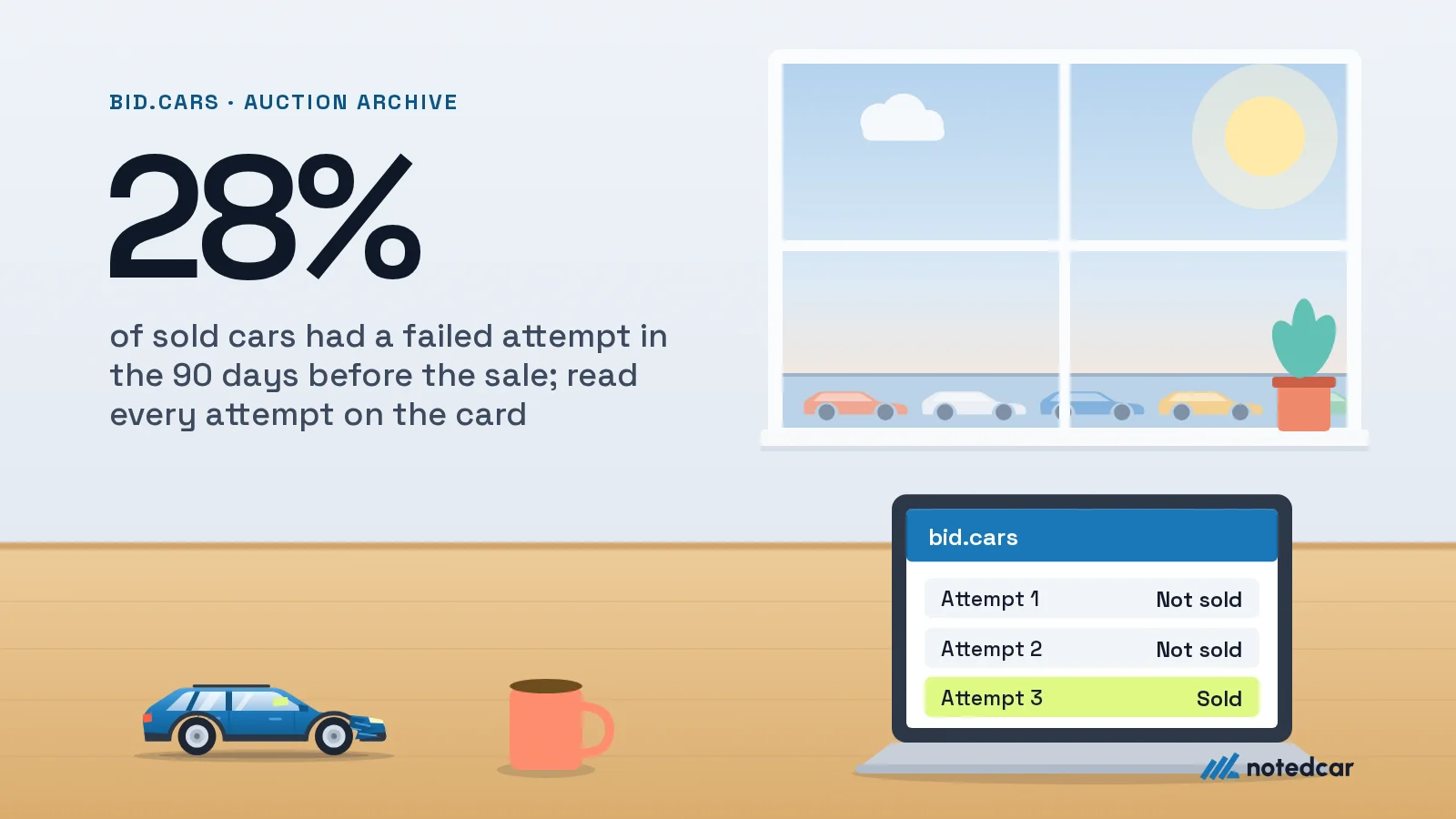
- Not sold with a figure — the seller declined that bid (a reserve or On Approval). It is a rejected bid, not a price. In our data for one week of October 2026 sales, 28% of sold cars had at least one failed attempt in the prior 90 days, and the final price was a median 25% above the last rejected bid. Treat it as a floor; the mechanics are in relists and rejected bids.
- Several rows, one VIN — a relist. Read the dates: a car that sat unsold for two months and then sold has a story a single row hides.
- A sale from years ago — not today’s market. In the same week, 4.6% of sold cars had been sold at auction before, at a median 0.55 of the earlier price: a car that came back to the auction usually came back cheaper and damaged again.
- Odometer and condition — the reading at assessment and the insurer’s primary damage code, both copied from the lot. Neither is verified.
The "Compare auctions" block lists similar cars from the archive and from the broker’s live listings. It is useful for a rough range and useless for a bid: it does not filter by trim, title type, run condition or seller, which is what moves the hammer price. Per-model medians with those splits are on our free sold price pages.
What the archive does not show
- Road history before the auction. Owners, accidents reported before the car went to Copart, service records, earlier title brands — none of it is on a lot page, so none of it is in any copy of one. That is the CARFAX report’s job (45 UAH at NotedCar, no account).
- Removed records. Paid services openly advertise removing a VIN from bid.cars and similar sites. A missing card is not a clean history.
- Downsized photos, no 360° or video. Archives keep reduced copies; the walk-around photos and engine videos Copart and IAAI shoot for part of their lots are not kept.
- Seller type. The card shows a seller name at best. Whether it was an insurer, a rental fleet, a dealer or a bank is one of the strongest price factors, and it is absent.
- The market around the car. You see one VIN. You do not see how many of the same model sold this month, for how much and with what damage — so you cannot tell whether this lot went cheap or dear.
- The hidden final bids. Where the figure is masked, the one thing you came for is the one thing missing.
The final bid is not the price in Ukraine
Every archive, bid.cars included, shows the hammer price. On top of it come the auction’s buyer fee and gate fee, inland delivery to the port, ocean freight, port handling, Ukrainian duty, excise and VAT, the pension levy at registration and the broker’s commission. On an $8,000 car those add up to more than the car. Three calculators do the arithmetic: the fee calculator for Copart and IAAI fees, the customs calculator for the Ukrainian payments and the USA import calculator for the whole landed cost in one pass.
A broker’s archive and independent data: a fair comparison
There is nothing wrong with a broker publishing an archive: it is useful, it is free, and bid.cars has run it for years (the site itself claims more than 16,000 cars imported since 2015 — a figure we have not checked). The difference is in what the publisher optimises for.
| BidFax on bid.cars | NotedCar archive | |
|---|---|---|
| Purpose | Brings buyers to the broker’s live lots | Sold-price data as the product |
| Search | VIN or lot number | VIN, lot number or filters by make, model, trim, year, odometer, damage, title, seller type and sale date |
| Final bid | Shown; hidden on part of the lots at the time of writing | Shown for every sale |
| Photos | Downsized copies | The full HD set, 360° and engine video where the auction shot them |
| Seller | A name at best | Name and type |
| Market context | A "Compare auctions" block of similar cars | Filters, monthly trends, per-model medians |
| Price | Free | $12 a month |
The archives do not compete on data: both are built from the same public lot pages. They differ in what is kept, how it can be searched and who pays for it.
When bid.cars is enough, and when it is not
- Checking one ad for a car already in Ukraine. bid.cars or any free archive: find the VIN, compare damage, odometer and title with the seller’s story, save the screenshots. Then a CARFAX for what happened before the auction.
- Weighing one live lot. The lot report at NotedCar is free after sign-up: every photo at full size, the title verdict and the VIN’s earlier runs under other lot numbers.
- Setting a bid. You need comparable sales, not one card. The sale history archive ($12 a month) filters Copart and IAAI sales in the US and Canada by what moves the price and shows seller type, 360° and video; how to turn comparables into a maximum bid is in Copart sold prices.
- Buying through a broker. If you plan to bid through bid.cars, its archive is a sensible place to start — just price the car with independent numbers before you set the maximum bid.
Every Copart and IAAI sale by VIN, lot number or filters — with the final bid on each, full photos, 360° and engine video.
Open the sale history