
Importing a US car to the UAE in 2026: 5% duty, 5% VAT, banned titles, GCC spec and a worked cost
How to import a Copart or IAAI car into the UAE (Dubai, Jebel Ali) as of 20 November 2026: 5% customs duty and 5% VAT, which damaged cars cannot be registered, US spec versus GCC spec, documents, transit time and a landed-cost example.
A US auction car can be imported into the UAE: Dubai Customs charges 5% duty on the assessed value and VAT is 5%, but not every damaged car can be registered. The Ministry of Industry and Advanced Technology (MoIAT) blocks used vehicles that are burnt-out, flooded, scrapped, dismantled or damaged beyond repair. Rules as of 20 November 2026; this covers Dubai and the Jebel Ali port. Check the VIN with MoIAT or a broker before you bid.
NotedCar does not ship cars to the UAE. We give you a free lot report, a title check and an auction fee calculator.
Duty and VAT
- 5% duty. Dubai Customs’ own page says the vehicle is evaluated by the Customs Valuation Department, inspected by customs officers, and duty is levied at 5% of its value.
- 5% VAT. Guides cite 5% VAT on imports, most often calculated on CIF plus duty, about 10.25% combined. That is not a Federal Tax Authority text we read, so confirm with a broker.
- Valuation. Customs may re-assess a value that looks too low against international price databases. An invoice for a cheap damaged car does not guarantee the assessment will match it.
- EVs and hybrids. We found no separate rate in the sources we read. Ask your broker.
Which titles and conditions can be registered
MoIAT launched an e-service for licensing imported used vehicles that blocks seven categories; the ones named are burnt-out, scrapped, flooded and disassembled cars, those damaged beyond repair and those with major manufacturing defects. The system checks against databases of the exporting countries.
- Flood, Fire, Non-Repairable, Parts Only: treat as out. A 2017 shipper article (WCS) says fire, flood, non-repairable, dismantled and parts-only brands cannot be imported for registration.
- Other salvage brands. The same shipper (2017) says most collision-damage cars can be imported, with the VIN checked online and a six-month licence issued per vehicle. It is a commercial, dated source and we did not confirm it against MoIAT’s text.
- Rebuilt. The sources conflict: Gulf News in 2018 lists rebuilt cars among the banned, while the shipper treats brands outside the list above as allowed. Do not buy a Rebuilt car for the UAE without confirmation for that VIN from MoIAT or a broker.
- MoIAT statement. A Product Status Statement confirms that a car can be registered in the traffic system. One guide puts the fee at about 200 dirhams; check the current one on the ministry’s site.
Read the lot’s title wording in the title check and the table of exportable titles, then compare salvage vs rebuilt and Certificate of Destruction.
Specification, steering side and age
- US specification. ArabWheels (August 2026) says American specification is not a problem by itself, but advises checking that warranty providers and workshops accept the exact VIN. Other guides require GCC specification, so confirm it for the specific car. The car must pass an RTA technical inspection before registration.
- Steering. The UAE drives on the right and left-hand-drive cars are the norm, so this is not a barrier.
- Age. One guide says there is no strict upper age limit; a shipper article mentions 10 years for registration without detail. Confirm with a broker.
Port and time at sea
The main port is Jebel Ali in Dubai. From the US East Coast ocean transit takes 3–5 weeks, per cfrclassic, which quotes East Coast budget figures of $1,450 roll-on/roll-off, $1,650 shared container and $3,300 full container. A car that cannot run is usually not accepted for roll-on/roll-off, so such lots need a container.
Documents
- Original invoice, packing list, bill of lading and a passport or Emirates ID copy (Dubai Customs).
- Lien-free title, bill of sale or auction invoice; the VIN must match.
- For a private importer, per the customs page, a passport copy and an invoice are enough.
- An RTA/Tasjeel technical inspection for registration; outside Dubai check your emirate’s requirements.
Worked example (illustration)
An illustration with rounded numbers, not a quote: an $8,000 lot, shared container from the East Coast.
| Line | Amount |
|---|---|
| Winning bid | $8,000 |
| Copart/IAAI fees (≈14%, proportions from our fees guide) | ≈ $1,100 |
| US yard to port trucking (assumption) | ≈ $500 |
| Ocean, shared container to Jebel Ali | ≈ $1,650 |
| Cost to Jebel Ali (CIF) | ≈ $11,250 |
| 5% duty on assessed value (assumption: = CIF) | ≈ $563 |
| 5% VAT on CIF + duty | ≈ $591 |
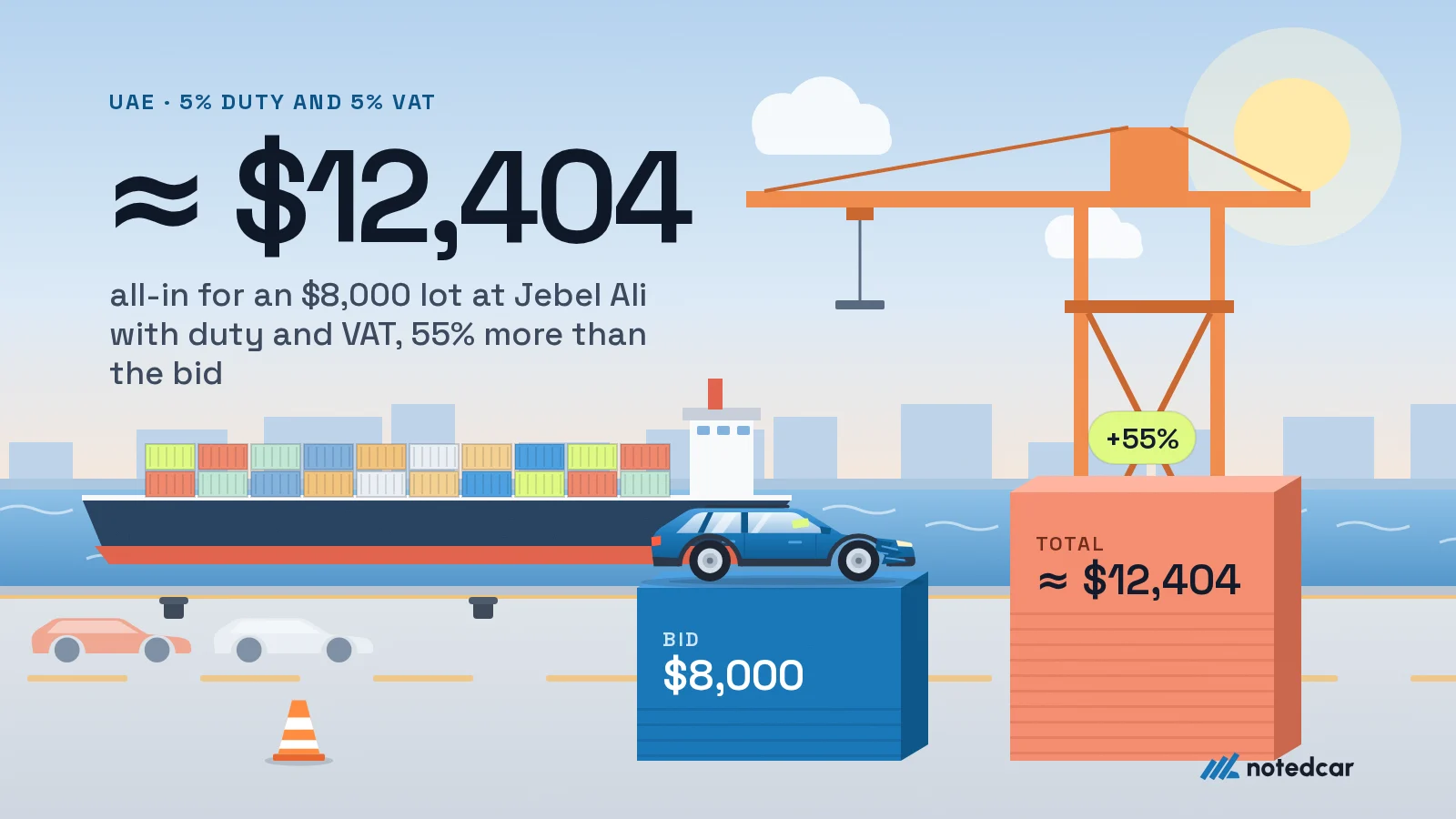
| Total in this scenario | ≈ $12,404 (+55% on the bid) |
What this changes in your bid
- The main risk is registration, not duty. A lot with Water/Flood or Burn damage, and often a Rebuilt title, may not be registrable.
- Check the VIN and title before bidding: the free lot report and the title check.
- Budget for repairs. A car with deployed airbags needs them replaced.
- Auction fees from the lot number come from the fee calculator.
Work out Copart and IAAI fees from a lot number and check whether a car with that title can leave the US, free and without signing up.
Calculate auction fees