
Importing a Copart or IAAI car into Canada in 2026: RIV, duty, GST, the 25% surtax and salvage titles by province
How to import a US auction car into Canada as of 20 November 2026: the RIV program and admissibility list, 6.1% duty or 0% under CUSMA, the 25% surtax on US-origin vehicles, GST/HST, excise, US export rules, and how Ontario, Quebec, British Columbia and Alberta treat salvage and rebuilt titles.
You can import a Copart or IAAI car into Canada, but a US-built car pays Canada’s 25% counter-surtax on top of GST, and a salvage car has a second inspection waiting in your province. The federal part is the Registrar of Imported Vehicles (RIV) program, a CBSA entry and a US export filing; whether a branded title can be registered is then decided by the province. Rules as of 20 November 2026, with the source for each figure beside it.
NotedCar does not bid for or ship cars to US or Canadian buyers. We give you a free lot report, a title check and an auction fee calculator.
The order of steps
- 1Before you bid. Check the model on Transport Canada’s admissibility list and the age (under 15 years), and read the title. Flood, junk, scrap or non-repairable cannot be registered at all.
- 2After you win. The US export filing to CBP at least 72 hours before departure, with the original title for the border.
- 3At the border. A Vehicle Import Form (Form 1), the title submitted electronically, and duty and taxes paid to CBSA. Without a title CBSA refuses entry.
- 4After release. RIV emails a case number; then any modifications, the recall work and the RIV inspection in Canada.
- 5Province. Registration, plus a separate provincial inspection for salvage and rebuilt cars.
The RIV program: admissibility, inspection, recalls
- Admissibility list. Transport Canada keeps a Vehicle Import Compatibility list built from information manufacturers supply voluntarily. The page itself says accuracy cannot be guaranteed and that an admissible vehicle may need modifications that are extensive and costly. A car that cannot be brought up to Canadian standards must be exported.
- Eligibility. Under CBSA memorandum D19-12-1 (revised 2 September 2026) the vehicle must be under 15 years old, sold at retail in the US or Mexico, not marked “inadmissible” on the list, and carry a US FMVSS compliance label or a manufacturer statement.
- Recalls. Outstanding manufacturer recalls block eligibility, and missing proof that a recall was done is described as a common reason for rejection.
- Inspection. The car must pass an RIV inspection in Canada before a province will register it. If it fails, RIV notifies the importer that the vehicle must be exported.
- RIV fee. CBSA Customs Notice 20-26 set C$325 plus taxes for a Form 1 and C$100 for a Form 3 (parts only) from 1 August 2020. We found no later official notice, and riv.ca could not be read by our tools, so confirm the current amount there.
Duty, surtax, GST and excise
- Duty. Cars built outside North America face 6.1%, and cars built in the US, Canada or Mexico enter duty-free under CUSMA. We saw the 6.1% only on pages mirroring the Customs Tariff, so check CBSA’s tariff for your code.
- 25% surtax. Since 9 April 2025 the Surtax Order (SOR/2025-118) charges 25% of the value for duty on motor vehicles that originate in the United States, new or used. For a vehicle entitled to the CUSMA tariff the base is smaller: 15% of the value is excluded by default, so the surtax lands on 85%, and a higher Canadian or Mexican content has to be documented. CBSA Customs Notice 25-15 says in terms that the surtax applies even if the vehicle qualifies for preferential tariff treatment.
- Origin. For personal imports a vehicle counts as US-origin when it is marked as a US good, and unmarked goods are treated the same until shown otherwise. Origin follows where the car was built, not where it was bought: a German-built car from a US auction should fall outside the surtax, but that has to be shown to CBSA.
- Relief. The 2026 Remission Order (imports from 9 April 2026 to 8 April 2027) covers importers named by business number, and CBSA states that it does not apply to personal importations. We found no repeal as of 20 November 2026.
- GST 5% is charged on the value plus duty and excise. In HST provinces the provincial part is collected at licensing, and elsewhere a province may charge sales tax at registration.
- Air-conditioning excise. C$100 on a car with an air-conditioning unit (memorandum D19-12-1, para. 47).
- Green Levy. An excise on cars with a weighted fuel consumption of 13 L/100 km or more, put into service after 19 March 2007. Pickup trucks are outside it. See CBSA for the scale.
- Luxury tax. Still payable on vehicles valued above C$100,000.
US export rules
Under 19 CFR 192.2 a person exporting a used self-propelled vehicle must give CBP the documents at least 72 hours before export, and at a land border the vehicle is presented at the time of exportation. The documents are the original title or a certified copy plus two copies, and a letter from the lessor or lienholder if the car is leased or has a lien. For a car without a title other documents can serve, such as a junk or scrap certificate or a bill of sale. Commercial sources add that the Census Bureau wants Electronic Export Information filed through AES 72 hours ahead as well. A broker or forwarder usually files this, and the 72 hours has to be planned before the car reaches the border.
Salvage, rebuilt and flood: federal rules, then the province
The federal and provincial rules differ, so take them in turn. CBSA memorandum D19-12-1 (Appendix A) lets a salvage-branded car be imported as a vehicle rather than for parts only, provided the brand is not junk, scrap, non-repairable, flood or water damage and the VIN is readable through the windshield. It must be rebuilt within one year of import, and be fully operational and CMVSS compliant when presented to RIV for the final inspection. Flood or water-damaged vehicles (Appendix D) are treated as junk and non-repairable and can only enter under the parts-only program. The CCMTA model program says the same from the provinces’ side: a US car with salvage status goes through RIV, and another jurisdiction may re-register it as rebuilt after inspection.
| Province | What the sources say | Confidence |
|---|---|---|
| Ontario | The brand carries over, but a rebuilt brand from another jurisdiction is downgraded to salvage, and a structural inspection at a DriveON VIC is needed to register it. Salvage cars may be towed, not driven. An archived 2021 MTO FAQ says imports branded for fire or flood receive an Irreparable brand. Source: ontario.ca, mandatory vehicle branding program. | Medium: we read it through a search summary, the page blocked our fetch |
| Quebec | Vehicles declared seriously damaged by an insurer, the owner or another administration (state or province) must pass a technical expertise and a mechanical check before returning to the road, and SAAQ first checks that the car was not declared irrecoverable elsewhere. Source: SAAQ guide for its agents (2023). | Medium: the PDF was not readable by our tools |
| British Columbia | Vehicles from other provinces and countries must be inspected at a BC Designated Inspection Facility. A car branded salvage, totalled or written off before needs a structural integrity assessment by a trade-qualified technician first. Flood-damaged vehicles cannot be licensed or insured in BC. Source: ICBC importing page and checklist. | High: read on ICBC pages |
| Alberta | Vehicles from another province or country usually need an out-of-province inspection, and the exemptions exclude salvage, non-repairable, unsafe, rebuilt and flood-damaged vehicles. A salvage car goes through a salvage inspection with a Rebuilt Vehicle Work Plan, after which the status becomes rebuilt; the certificate goes to a registry within 14 days. Source: Alberta.ca. | High: read on Alberta.ca |
Land transport and the border crossing
From the yard to the border the car moves on a carrier or a flatbed, and the price has to come from a carrier: there is no official rate, so the example below uses an assumption. Three things run separately from the haul. First, the 72-hour US export filing. Second, the CBSA declaration at a port of entry, where individuals can present at any port (memorandum D19-12-1, para. 16). Third, once CBSA releases the car, RIV emails the case number and the RIV inspection and any modifications happen inside Canada. A car that does not run cannot drive itself to the inspection, so budget for a tow.
Worked example (illustration)
An illustration with rounded numbers, not a quote. A US$8,000 lot converted at an assumed US$1 = C$1.40, auction fees taken as US$1,100 (proportions from the fee guide), trucking to the border as an assumed C$1,000, the value for duty as bid plus fees, and GST charged on the value plus surtax and excise. CBSA decides what counts in the value.
| Item | US-built car (CUSMA) | Car built outside North America |
|---|---|---|
| Bid, US$8,000 | C$11,200 | C$11,200 |
| Auction fees (≈ US$1,100) | C$1,540 | C$1,540 |
| Trucking to the border (assumed) | C$1,000 | C$1,000 |
| Duty | 0 | 6.1% = C$777 |
| 25% surtax | 25% of 85% of the value = C$2,707 | none (not US-origin) |
| A/C excise | C$100 | C$100 |
| GST 5% | C$777 | C$681 |
| RIV fee C$325 plus tax (at 5% GST) | ≈ C$341 | ≈ C$341 |
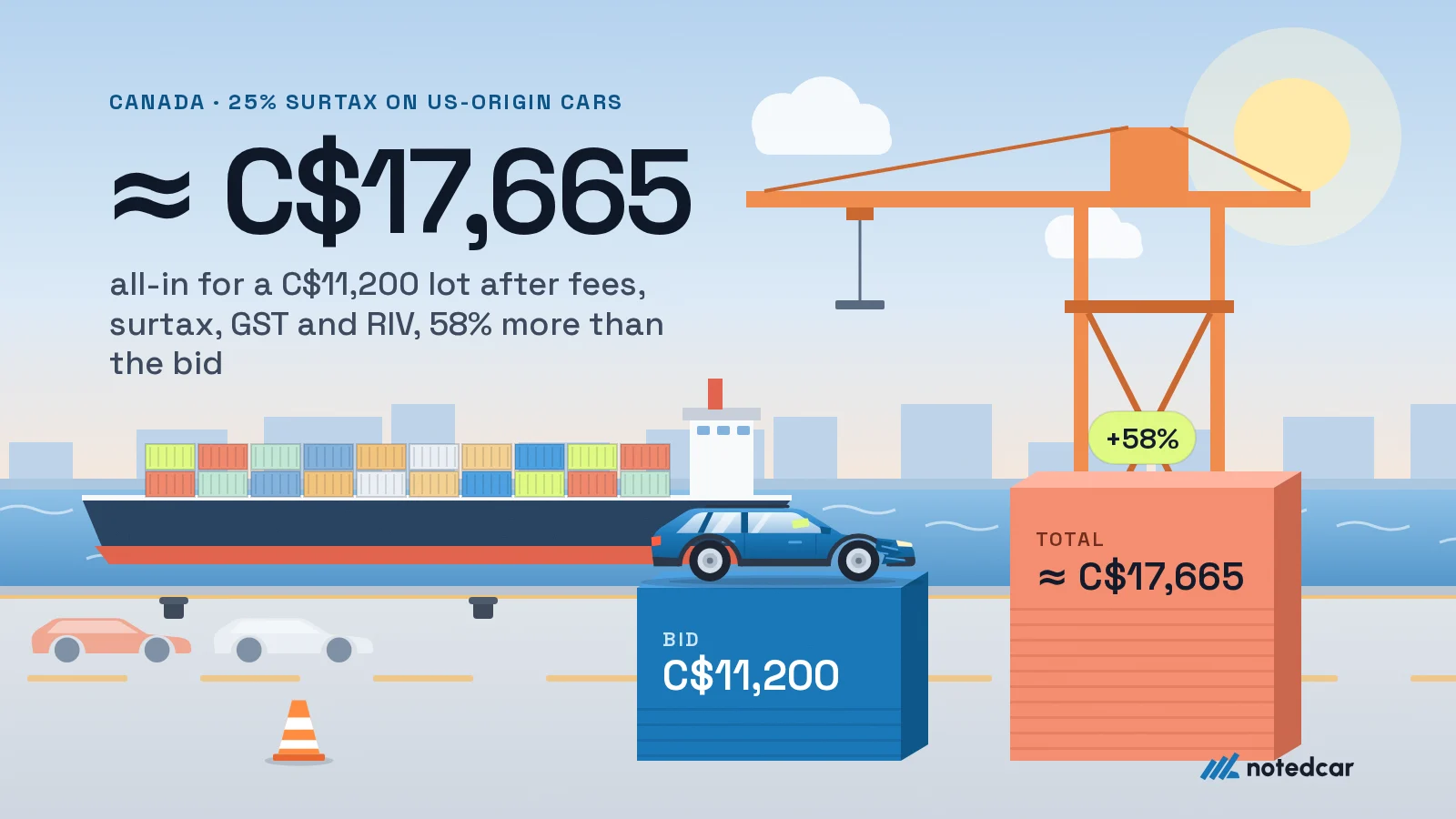
| Total | ≈ C$17,665 (+58% on the bid) | ≈ C$15,639 (+40%) |
What this changes about your bid
- Title and VIN before the bid. Flood, junk, scrap and non-repairable cannot be registered, and salvage and rebuilt need a provincial inspection: use the free lot report, the title check and the export titles guide.
- Check admissibility. The model and year have to be on Transport Canada’s list, and the scale of modifications is better known before the bid.
- Budget the surtax. For a US-built car it is the largest single line after the bid.
- Budget the repair. A salvage car has to be rebuilt within a year of import and then pass the provincial inspection.
- Auction fees by lot number come from the calculator.
Calculate Copart and IAAI fees by lot number and check the title, free and without signing up.
Calculate auction fees