
Importing a US car to Jordan in 2026: tax by engine type, Zarqa free zone, Aqaba, the salvage ban and a worked cost
How to import a Copart or IAAI car into Jordan as of 20 November 2026: special tax and sales tax by engine type, the Zarqa free zone, age limits, the ban on salvage and junk titles, Aqaba port and a landed-cost example.
A US auction car can be imported into Jordan, but not with a salvage or junk title: those have been banned since November 2025, and taxes on a petrol car come to about 51% of customs value. Rules as of 20 November 2026. We could not open the Jordan Customs or Petra sites from our network, so the rates below come from Jordan News, Jordan Times and shipper reports, not from an official text. Check the VIN and the rates with a licensed clearing agent before you bid.
NotedCar does not ship cars to Jordan. We give you a free lot report, a title check and an auction fee calculator.
Special tax and sales tax
- Petrol and hybrid. On 28 June 2025 the Cabinet cut total taxes (general plus special) on petrol cars from 71% to 51% and on hybrids from 60% to 39%. Jordan Customs began applying the new rates on 29 June 2025.
- Electric. The special tax was fixed at 27% for every category regardless of price, replacing a schedule that was to climb to 55%.
- 16% sales tax. Reports say it applies to every vehicle type: petrol, hybrid and electric.
- Engine size. In the reports we read the rates differ by engine type, not by cubic capacity. Confirm for your car with a broker.
- Our split of the totals. The 51% and 39% are two taxes added together. A special tax of 30% and 20%, plus 16% sales tax on value plus special tax, reproduces exactly 51% and 39%. That is our arithmetic, not an official table.
- Customs duty. One guide reads the tariff as exempting passenger cars (code 8703) from duty. We could not confirm it, so ask a broker.
Where sources disagree: guides give different special-tax figures for hybrids, and EVs and hybrids cleared before the 28 June 2025 decision were reported exempt from the new sales tax (about 800 to 900 vehicles).
Which titles and conditions are allowed
- Salvage and Junk. Per Jordan News and Petra, since November 2025 vehicles classed as salvage or junk in their country of origin are banned, along with those with severe fire or flood damage. Before that, an official said about 40,000 salvage vehicles a year entered under special exceptions.
- Effect on US lots. The vice president of the Jordanian Free Zones Investors Association tied a 65.3% fall in Zarqa clearances in the first five months of 2026 to these rules, which he said halted salvage-title cars from the US and Canada.
- Rebuilt and clean. The reports we read do not discuss Rebuilt titles. Do not buy a Rebuilt car for Jordan without a broker’s confirmation for that VIN.
- Check before you bid. Read the lot’s title wording in the title check and the table of exportable titles, then compare salvage vs rebuilt.
Age, standards and car type
- Electric. Importing an EV more than three years old is banned, counting the year of customs clearance (Jordan News). In 2026 that means model years 2026, 2025 and 2024.
- Petrol and hybrid. The shipper WCS says a personal import must be five years old or newer and a business import has no age limit. We did not find this in an official Jordanian text, so confirm with a broker how the year is counted.
- Technical standards. Since November 2025 passenger cars (petrol, hybrid, electric) must meet Jordanian specifications tied to European, American, Gulf or Saudi standards. American specification is on that list, but your broker confirms the specific car.
- Diesel. One guide says diesel passenger cars are not allowed. We could not confirm it, so check.
Zarqa, Aqaba and time at sea
Jordan’s only seaport is Aqaba. WCS gives 28 days from New Jersey and 45 days from Florida, with a general range of 30–45 days in its FAQ. Its port-to-port shared-container prices are $3,875 from Florida and $5,700 from New Jersey, excluding pickup, destination charges, duty and taxes. These are estimates, not quotes.
- The Zarqa Free Zone has historically been a hub for assembly and re-export of vehicles to Iraq, Syria and Libya, and a route for clearing cars into the domestic market. An older Jordan News piece says many salvaged cars were repaired inside the zone and only then inspected.
- Re-export versus domestic. A car that leaves Zarqa for another country does not go through domestic clearance. For a buyer who wants the car in Jordan, domestic clearance is the step that matters.
- Clearing a car out of the zone. According to Jordan Customs’ government-portal page (we only saw its search description), you present proof of ownership from the country of origin, delivery and discharge documents, and a discharge request signed by the zone director. Customs assesses the value, then you pay duty, taxes and licensing fees.
- Volumes. Domestic-market clearances at Zarqa fell 65.3% in the first five months of 2026, to 8,214 vehicles from 23,691. Electric fell 85.7%, hybrids 65.5%, and petrol rose 8%.
Documents
- For shipping from the US (per WCS): the original lien-free title, bill of sale, power of attorney, passport copy, a completed shipping form and a Jordan import declaration. Older cars from states that do not issue titles need a separate check.
- For clearing in Zarqa: proof of ownership, delivery and discharge documents, and the discharge request (above).
- The full list, standards conformity and the inspection at Aqaba that one shipper mentions are for a licensed broker to confirm.
Worked example (illustration)
An illustration with rounded numbers, not a quote: an $8,000 lot that is not salvage or junk, a car under five years old, a shared container from Florida to Aqaba at the WCS figure. Special tax uses our split (30% petrol, 20% hybrid, 27% electric), sales tax is 16% of value plus special tax, and duty is assumed 0%.
| Line | Petrol | Hybrid | Electric (under 3 years) |
|---|---|---|---|
| Winning bid | $8,000 | $8,000 | $8,000 |
| Copart/IAAI fees (≈14%, proportions from our fees guide) | ≈ $1,100 | ≈ $1,100 | ≈ $1,100 |
| US yard to port trucking (assumption) | ≈ $500 | ≈ $500 | ≈ $500 |
| Ocean, shared container to Aqaba (WCS figure) | ≈ $3,875 | ≈ $3,875 | ≈ $3,875 |
| Cost to Aqaba (CIF) | ≈ $13,475 | ≈ $13,475 | ≈ $13,475 |
| Special tax (30% / 20% / 27%) | ≈ $4,043 | ≈ $2,695 | ≈ $3,638 |
| 16% sales tax on CIF + special tax | ≈ $2,803 | ≈ $2,587 | ≈ $2,738 |
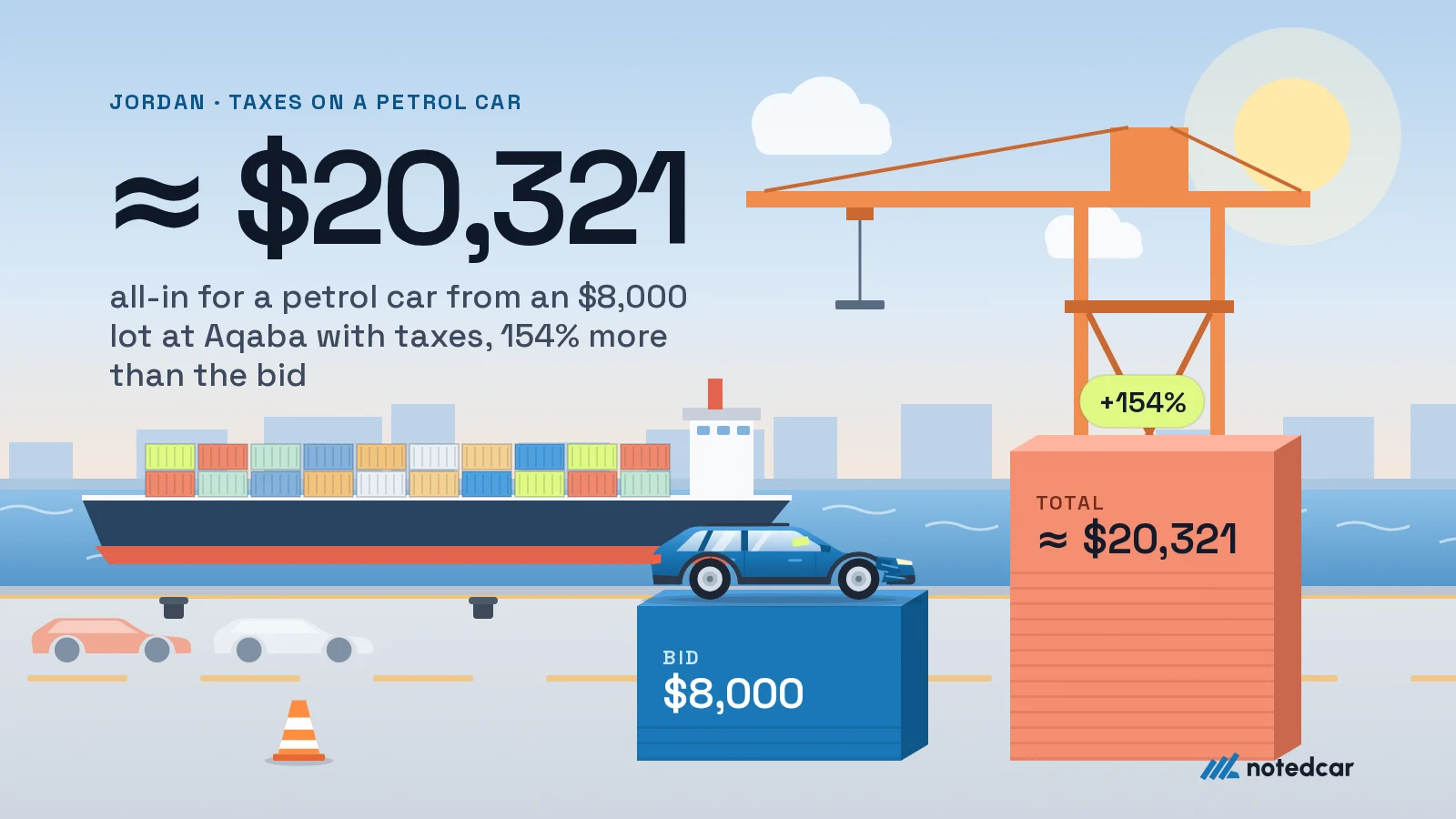
| Total in this scenario | ≈ $20,321 (+154%) | ≈ $18,757 (+134%) | ≈ $19,851 (+148%) |
What this changes in your bid
- The title decides everything. A lot with Salvage, Junk, Water/Flood or Burn is not a Jordan lot. Check it before bidding.
- Model year. An EV no older than three years; a petrol or hybrid up to five for a personal import, per the shipper.
- Taxes of about half the value. Build them into your maximum bid instead of adding them after you win.
- Auction fees from the lot number come from the fee calculator, and the free lot report shows the title and damage.
Work out Copart and IAAI fees from a lot number and check whether a car with that title can leave the US, free and without signing up.
Calculate auction fees