
How to search Copart and IAAI: the filters that actually matter

The Copart and IAAI catalogue holds tens of thousands of lots and you need one car. Which filters really narrow the field, which to leave off, an example search, and what the market over- and under-pays for by label.
·5 min read
An auction yard where one damaged blue crossover marked “Run & Drive” stands out from a row of grey cars: the filters leave a single fitting lot out of the catalogue

If this is your first personal purchase for import to Ukraine, start with the step-by-step US car buying guide: total budget, bidding access, lot checks and purchase assistance.

The Copart and IAAI catalogue is tens of thousands of lots and most of them are not for you. For a private buyer who needs one car the problem is not too little choice but too much, with every card looking the same. Below: which filters actually matter, in which order to set them and what the labels on a lot mean.

Filter order: from hard to soft

Start with what is non-negotiable and move towards what can be judged separately. The hard conditions are make, model and years: they decide everything from price to customs cost. The soft ones are colour, trim, state and exact mileage: better looked at on the lot itself than cut in advance, because every such filter throws away a potentially best option.

  1. 1Make, model, a year range (2–3 years).
  2. 2Damage: which types you are willing to take.
  3. 3Condition: does it drive.
  4. 4Title type: what you can import and resell.
  5. 5Odometer: an upper limit only.
  6. 6Location: last, if at all.

Damage: what to select and what to inspect

The primary damage filter has the biggest influence on repair cost. The filter works as a selection: tick the types you are willing to restore, for example Front End, Rear End, Side, Mechanical. Most buyers leave fire (Burn) and flood (Water/Flood) unselected, and take Rollover only if they can judge a body. Look at the photos of the types you pick: the code says where the car was hit, not how hard. How to read the codes is in the damage code guide.

The market prices labels that look similar very differently. In an analysis of 143,989 sales, lots with Rollover closed at 0.54x the price of comparable cars without the label and Burn at 0.60x: few people buy them, so this is where the biggest discount sits for someone who can judge a body from photos. Conversely, Hail went for 1.66x and minor dents and scratches 1.37x: the market overpays for “safe” labels. If you want a car without surprises that premium is the price of peace; if you are hunting for value, that is where it is not.

Condition, keys and airbags

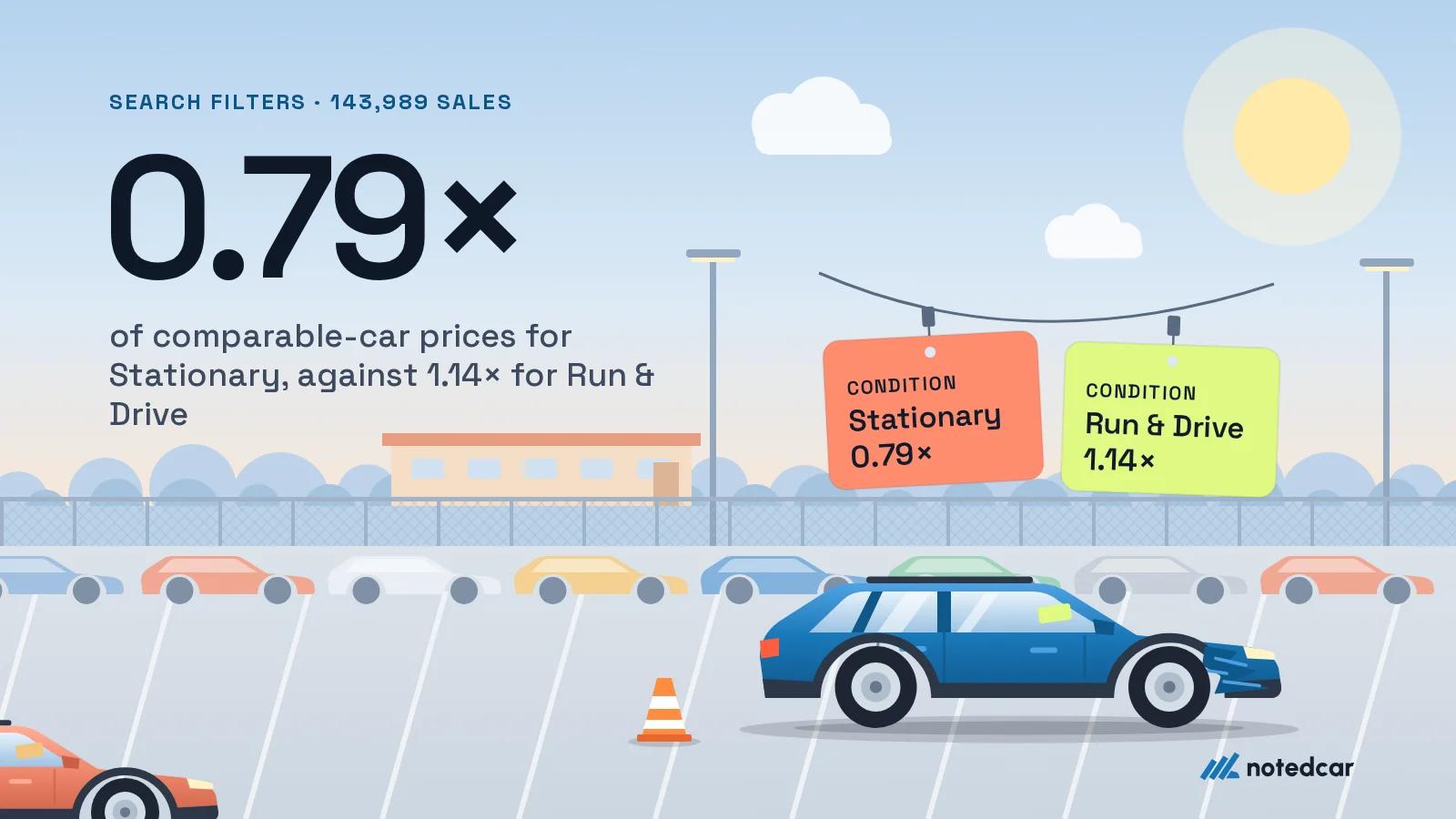
The condition label tells you whether the car starts and drives: “Run & Drive” means the auction checked that it moves under its own power, “Stationary” that it does not. The market prices the difference heavily: Stationary closed at 0.79x against 1.14x for Run & Drive. A “Run & Drive only” filter is convenient but costly: you pay for a guarantee you may not need if you repair the car yourself or are shipping it to a workshop anyway. Lots with no keys went at 0.80x, with deployed airbags at 0.82x. If you plan a full rebuild these are good signals; if not, check what putting them right will cost.

Title: the most important filter

The title is the car’s document, and its type decides whether you can import the car and what you can resell it for. Clean and original titles went for 1.24–1.59x comparable cars, while Non-repairable and Certificate of Destruction only 0.53–0.81x, and those cars often cannot be imported legally. So the title is not “one more filter” but a condition worth setting first. Details in the guides to US car titles and salvage vs rebuilt.

Odometer: why only an upper limit

The mileage on a lot is often approximate and sometimes marked as not verified. Set an upper limit with some slack and no lower one: a low-mileage car is no worse, and filtering it out loses the best options. The real mileage is checked separately, in a VIN report: see how to check a car’s history by VIN.

State and yard: set them last

The state affects inland shipping to the port but rarely the price of the lot itself, so restricting it up front is often a mistake: you drop a lot that would have been cheaper even with dearer shipping. Find the lot first, then work out its full cost in the fee calculator and the USA import calculator. If you know that only a certain port suits you, one search for it makes sense.

Sale type

Pure Sale, On Approval and Seller’s Reserve are different guarantees that the lot will be sold at all: on some your bid is accepted automatically, on others the seller decides after the auction. This is not a search filter but something to look at on the lot. It is all in the guide to sale types.

Example: searching for a sedan for yourself

The buyer wants a 2018–2020 Honda Accord that a mechanic friend will repair. They set make, model and years, select Front End, Rear End and Side damage (leaving fire and flood unselected), keep both Run & Drive and Stationary (it goes to the workshop either way), set an odometer ceiling and pick a title they can import. They do not restrict the state. The result is not one car but a short list of lots worth going through by hand.

Then the “shortlist of five” rule applies: from the selected lots, set aside the five best by photos, open the free lot report for each, work out the full cost and only then decide which one to bid on. Drop the rest without regret: the next batch of new lots is already on its way.

Save a search once and matching new Copart and IAAI lots come to you: up to 10 searches on the Car search plan.

About the Car search plan

Common search mistakes

  • Setting every filter at once: an empty result does not mean there are no cars, only too many conditions.
  • Demanding Run & Drive at any price without working out what its absence costs.
  • Searching for “the cheapest”: the cheapest lots are Rollover, Burn and risky titles, not bargains.
  • Looking only at the main photo and the damage code.
  • Not repeating the search: the catalogue changes daily and a manual search happens once a week.

How to stop searching from scratch

Once the filters are right, save them. On the Car search plan you can keep them as saved searches (up to 10) and get alerts for new lots by email, browser push, in the app and in Telegram. A free account keeps one saved search and sends a weekly “N new cars match your search” email. How to set those alerts up is in the article on new-lot alerts. The plan is $12 a month or $115 a year with a 7-day free trial and no card; the trial starts after you confirm the account in our Telegram bot.

Frequently asked questions

Keep reading

Importing a US car to Armenia in 2026: the EAEU flat payment, the environmental tax, the Poti route and a worked cost

Armenia is in the EAEU: a private importer pays one flat payment on cubic centimetres and age, a company pays duty plus VAT. The table, the open points and a worked $8,000 lot.

Importing a US car to Azerbaijan in 2026: duty, excise, 18% VAT, the 10-year limit and a worked cost

Azerbaijan does not admit cars over 10 years old, and excise has risen since 2026 for cars over 7. What is confirmed, where sources disagree and a worked $8,000 lot.

Importing a US car to Iraq in 2026: duty, the damaged-car ban, ports and a worked cost

Iraq changes its car rules every year and the sources disagree even on the duty rate. What can be stated, what cannot, and how to budget with a margin.

Importing a US car to Libya in 2026: age limit, duty, Misrata and Khoms, and a worked cost

Libya charges on a customs-estimated value, and the age limit is anywhere from 5 to 10 years depending on the source. What is known, what is not, and the port most US cars use.

Importing a US car to the UAE in 2026: 5% duty, 5% VAT, banned titles, GCC spec and a worked cost

The UAE has the clearest rates of the three destinations, but it will not register a car after flood or fire. Duty, VAT, titles and a worked illustration.

Importing a US car to Jordan in 2026: tax by engine type, Zarqa free zone, Aqaba, the salvage ban and a worked cost

Since November 2025 Jordan will not take cars with a salvage or junk title, and taxes on a petrol car come to about half the customs value. Rates, Zarqa, Aqaba and a worked illustration.

Importing a US car to Nigeria in 2026: 20% duty and levies, the 12-year age limit, VIN valuation, Lagos ports and a worked cost

Nigeria reportedly bars cars over 12 years old and values them by VIN, while the levy rates differ from source to source. What is known, what is not, and a worked illustration.

Importing a Copart or IAAI car into Canada in 2026: RIV, duty, GST, the 25% surtax and salvage titles by province

The RIV list, duty, the 25% surtax on US-origin cars, GST and how the provinces treat salvage and rebuilt titles, with a worked illustration.

Copart and IAAI without a dealer license: what US residents can bid on in 2026

A private buyer in the US cannot bid on every lot. What is open, where a broker is needed, what brokers charge and what to check first.

Buy a car from the USA yourself: choosing a lot and importing to Ukraine

Keep control of the car you choose and your bid limit. A practical path through search, alerts, checks, import costs and purchase assistance.

Copart Vehicle Alerts and IAAI new-lot alerts: how not to miss the car you want

A saved search with the right filters beats scrolling the catalogue every day. How to set one up and what to do with the alert.

When to buy on Copart and IAAI: wait for the right lot or take the first

Listing age, sale day and the rejected bid: when it pays to wait and when to bid straight away. Figures from an analysis of Copart and IAAI sales.

BidFax alternative: Copart sale history by VIN with 360° photos

What BidFax shows, what it leaves out and where to see Copart and IAAI sale history by VIN with every photo, 360° and market-wide filters.

Copart sold prices: how to find out what a car sold for at auction

Copart does not show final prices. Where to find them, how to read them and how to work a maximum bid back from them.

Copart and IAAI lots that sell below market: what 144,000 sales show

Listing age, live auctions, dealer sellers and a few states predict a sale at 0.65x the modelled price.

Copart rejected bid: why it is the floor of the price, not the ceiling

Relists sell at 1.25x the rejected bid; only 11% go for less. Data from 2,000 VIN chains.

Stat.vin explained: the free Copart and IAAI sale archive, how to read a card and what it leaves out

A free archive of Copart and IAAI auctions on a broker’s site: how to use it, how to read a card and where it stops.

Bid.cars alternative: Copart sale history by VIN, all photos

What the bid.cars archive shows, what it leaves out and where to see Copart and IAAI sale history by VIN with every photo, 360° and market-wide filters.

BidFax alternatives: the sites that show Copart and IAAI sale history by VIN, compared

bidfax.info, bid.cars, stat.vin, finalbid.vin, autohelperbot, autoastat and the NotedCar archive in one table.

How to read a CARFAX report: what to check before you bid

One owner does not mean no damage. Read the summary alongside the actual events.

MV-907A title check: how to look up a New York salvage certificate and liens on the DMV site

One in three lots from New York sells on an MV-907A certificate. The state DMV lets you check for an active lien in a minute, free and without an account.

How Copart works: buying a car as a foreign buyer

Who is allowed to bid at Copart, how much you need on deposit before the first bid, and where a broker fits. The auction’s mechanics from sign-up to a won lot.

EV customs in Ukraine in 2026: 20% VAT, €1 per kWh excise and worked examples

The VAT exemption ended on 1 January 2026. An electric car now costs a little over 20% of its value to clear — here is the formula and the numbers.

Copart and IAAI glossary: lot page terms and how to read the invoice

Every flag on a lot page means less than it sounds like. Here is what each one actually records — and what it does not promise.

Certifying a US car in Ukraine: first registration and the 2026 rules

A cleared car still cannot be registered. Between customs and plates sit certification, a lighting conversion and the pension fund fee.

Certificate of Destruction: what it means and whether the car can be exported

The cheapest lots at auction often carry this document. Legally it is no longer a vehicle but a set of parts — and that changes everything.

Salvage vs Rebuilt title: the difference and what it does to the price

Salvage is a car an insurer wrote off. Rebuilt is the same car after repair and inspection. The gap between them is weeks, money and a question of trust.

After winning a Copart lot: payment deadline, storage, late fees and relist

The clock starts when the hammer falls. Three business days to pay, then a late fee, then storage every day — and eventually your lot is sold again at your expense.

How much a Rebuilt Title cuts a car’s value: how to estimate it and set your bid

The 20–40% rule is only the start. The real discount depends on the damage type, the paperwork and the model — and it decides how much you can pay for the lot.

How to track a car shipped from the US: stages, numbers and where to check

There is no single “track by VIN”: every leg of the journey has its own number and its own place to look. Here is the map of the whole route.

Importing a US car to Georgia in 2026: the 1.5 and 4.5 GEL excise, import tax and worked examples

Since April 2026 a car’s age matters more than its price in Georgia: the seventh year triples the excise. The formula, examples and what it does to your bid.

Importing a US car to Kazakhstan in 2026: 15% duty, 16% VAT, the recycling fee and the 500 MRP registration

In Kazakhstan the biggest charge is not duty but first registration: 500 MRP for a car over three years old. Here is how that changes which lot you pick.

Importing a US car to Kyrgyzstan in 2026: the EAEU flat rates in euro per cm³, with examples

In Kyrgyzstan the bill is computed from cubic centimetres, not price — and a car’s fifth year doubles the rate. The full table and three examples.

Importing a US car to Uzbekistan in 2026: 40% + $3 per cm³ duty, and why to run the numbers first

On a car over three years old, duty alone in Uzbekistan exceeds the price of the car. Here is the formula and the categories where importing still works.

Copart and IAAI fees in 2026: every buyer charge and how to price a lot properly

Your bid is roughly 75–85% of what you actually pay the auction. Here is every Copart and IAAI charge, what moves it, and how to price a lot before you bid.

Landed cost of a US car: from the auction bid to customs clearance

The auction bid is roughly half of what you will pay. Here is the other half — and how to work your maximum bid backwards from the margin you need.

Pure Sale, On Approval and Seller's Reserve: Copart and IAAI sale statuses explained

Winning the auction and buying the car are not the same thing. Here is what every Copart and IAAI sale status means for your bid.

Can you export a US salvage title car: which titles can leave the US (2026)

Most Salvage, Rebuilt and Flood titles can be exported; Bill of Sale lots need a conversion first. The title types and how to check yours.

Copart and IAAI damage codes: which ones actually destroy your margin

Translating a damage code is easy. Knowing which ones cost a hundred dollars and which close the deal before you bid is the part that matters.

How to check a US car's history by VIN: Carfax, AutoCheck and their blind spots

A VIN report is the cheapest way to avoid buying someone else's problem. But its limits deserve as much attention as its contents.

Window sticker by VIN: how to check factory equipment on a US car

An auction listing gives you three lines. The factory sticker tells you exactly how the car left the line and what it cost when new.

Looking for one car from a US auction?

Live Copart and IAAI lots with photos and the current bid, up to 10 saved searches and alerts for new lots by email, browser push, in-app and Telegram. $12 a month, 7 days free with no card.