
Importing a US car to Armenia in 2026: the EAEU flat payment, the environmental tax, the Poti route and a worked cost
How to clear a Copart or IAAI car in Armenia as of 20 November 2026: the EAEU flat rates in euro per cm³ for private importers, 20% VAT and duty for companies, what is unclear about the environmental tax, electric vehicles, the port of Poti and a worked cost for an $8,000 lot.
Yes, a US auction car can be imported into Armenia, and for a private importer the payment follows a readable table: the EAEU flat rate in euro per cm³ depends on age and engine size, not on price. For cars over three years old the price does not enter at all. Data as of 20 November 2026. What stays unclear (the environmental tax, parts of the electric-vehicle relief) is marked below; confirm it with a licensed customs broker in Armenia before you bid.
NotedCar does not ship cars to Armenia: we provide tools to know the auction fees, the title and the lot history before you bid. Below is what the sources support, with a note wherever they disagree.
Flat rates for private importers
Armenia is a member of the EAEU. Passenger cars imported from third countries by private persons for personal use fall under the flat rates in Annex 2 to EEC Council Decision No. 107 of 20 December 2017 (table 2). The rate replaces duty, excise and VAT: a private person does not pay them separately. Under the 14 April 2020 Protocol to Armenia’s accession treaty, the transitional national rates for such cars applied until Armenia started applying the EAEU Common Customs Tariff rates; reference sources date that to 2020.
| Engine size | Car 3 to 5 years old | Car over 5 years old |
|---|---|---|
| Up to 1,000 cm³ | 1.5 euro per cm³ | 3.0 euro per cm³ |
| 1,000–1,500 cm³ | 1.7 euro per cm³ | 3.2 euro per cm³ |
| 1,500–1,800 cm³ | 2.5 euro per cm³ | 3.5 euro per cm³ |
| 1,800–2,300 cm³ | 2.7 euro per cm³ | 4.8 euro per cm³ |
| 2,300–3,000 cm³ | 3.0 euro per cm³ | 5.0 euro per cm³ |
| Over 3,000 cm³ | 3.6 euro per cm³ | 5.7 euro per cm³ |
For cars under three years old the payment is based on value: 54% up to 8,500 euro and 48% above it, but never less than a per-cm³ minimum that rises with price (from 2.5 to 20 euro per cm³). Armenian customs counts age from the manufacture date to the calculation date, and uses 1 July when only the year is known (EEC Board Decision No. 74 of 30.06.2017, as described in the State Revenue Committee’s calculator). A 2021 car near the 3–5 / over-5 line can therefore land on either side depending on the month of clearance.
Private person and company: two different calculations
Customs decides whether use is “personal” from the nature and frequency of imports. A company importing cars for resale clears them under the general procedure: import duty under the EAEU Common Customs Tariff, then 20% VAT on the customs value plus duty (and excise where there is any). Brokers describe no excise on passenger cars in the Armenian Tax Code. Broker sites put duty at “about 15%” for a new petrol car and higher for a used one, and they differ on the detail, so we give no company figure in the worked cost.
A dealer buying for clients should ask the broker in advance in which capacity each car will be cleared. We do not say the private-person route can be used for resale: customs decides that.
Environmental tax: the sources disagree
Besides the customs payment, Armenia has an environmental tax on imported cars. We could not read the rates in the Tax Code itself, and the sources contradict each other:
| Source | What it says |
|---|---|
| LandedCar (cites Tax Code article 171) | From 2% for cars up to 3 years old to 24% over 15 years, as a percentage of customs value. The site itself notes the State Revenue Committee calculator counts age differently |
| Brokers.am (customs broker) | Paid by legal entities when the car is over 5 years old; example: a 6-year-old car, 2% |
| Carawon (intermediary) | A small fixed sum by engine size; example $60 for a 2.5 L |
The worked cost below leaves the environmental tax out. For a 3–5-year-old car at the most cautious reading (4% of value) it would be hundreds of dollars; for a car over five years old it matters more. Treat it as a budget margin until you have the number from the State Revenue Committee calculator.
Electric and hybrid vehicles
- Duty. According to Armenpress, the EAEU gave Armenia a duty-free quota for 15,000 electric vehicles in 2026; one broker site, citing a government decision, says 20,000. After the quota runs out, LandedCar describes a 15% rate. We could not resolve the difference.
- VAT. The VAT exemption for electric vehicles runs through 31 December 2026 on the same reports; LandedCar quotes the Economy Ministry as saying it ends on 1 January 2027. If the car arrives in early 2027, plan for 20% VAT.
- The table above covers petrol and hybrid cars. LandedCar reports that electric vehicles sit outside the flat rate and pay under the ordinary tariff. Confirm with a broker before buying.
Titles, damage and steering side
- Salvage and damaged cars. We found no Armenian rule about the word Salvage on a US title. Customs works from the VIN, year, engine size and value; whether a wrecked car passes the technical inspection and registration with the traffic police depends on its condition, and that is a question for before the bid.
- Right-hand drive. Brokers report that right-hand-drive cars are not registered in Armenia. For US cars this is not a problem.
- Age. We found no statutory age ban for private imports. The limit in practice is the table itself: the older the car, the higher the rate.
Read the lot’s title wording first in the title check and the export-title reference; our pieces on salvage and rebuilt give the wider picture.
Route: Poti, then overland
Armenia has no coastline, so the car goes by sea to the Georgian port of Poti (or Batumi) and then by truck via Sadakhlo or Bagratashen to Yerevan. Shippers quote about 35 days from the US East Coast to Poti and 3–5 days by road. These are carrier estimates, not quotes; a car that cannot run usually needs a container, where 3–4 cars travel together.
Georgia does not charge excise on a car in transit: it arises on release into free circulation in Georgia. The port and transit are covered in our Georgia guide. In Armenia a transit declaration moves the car from the border to an inland customs office, then a goods declaration is filed and the payments are computed from it.
Documents
- Original lien-free title, auction invoice or bill of sale, a passport copy; the AES/EEI export filing is handled by the forwarder.
- Bill of lading and commercial invoice; the VIN must match on every document.
- The transit and goods declarations filed in Armenia (usually through a broker).
- For registration: the customs clearance document, technical inspection, insurance and ID. State duties are small and sources quote them differently (3,500 and 5,000 dram per declaration), so confirm those too.
Worked example (illustration)
This is an illustration with rounded numbers, not a quote. Assumptions: an $8,000 lot, a 2022 sedan with a 2.0 L engine (1,998 cm³), about 4.5 years old at clearance, a private importer, $1.15 per euro.
| Line | Amount |
|---|---|
| Winning bid | $8,000 |
| Copart/IAAI fees (≈14%, proportions from our fees guide) | ≈ $1,100 |
| US yard to port trucking (assumption) | ≈ $500 |
| Ocean to Poti (assumption, not a quote) | ≈ $1,650 |
| Cost at Poti | ≈ $11,250 |
| Poti to Yerevan by road (assumption) | ≈ $700 |
| Flat payment: 1,998 cm³ × 2.7 euro = 5,395 euro | ≈ $6,200 |
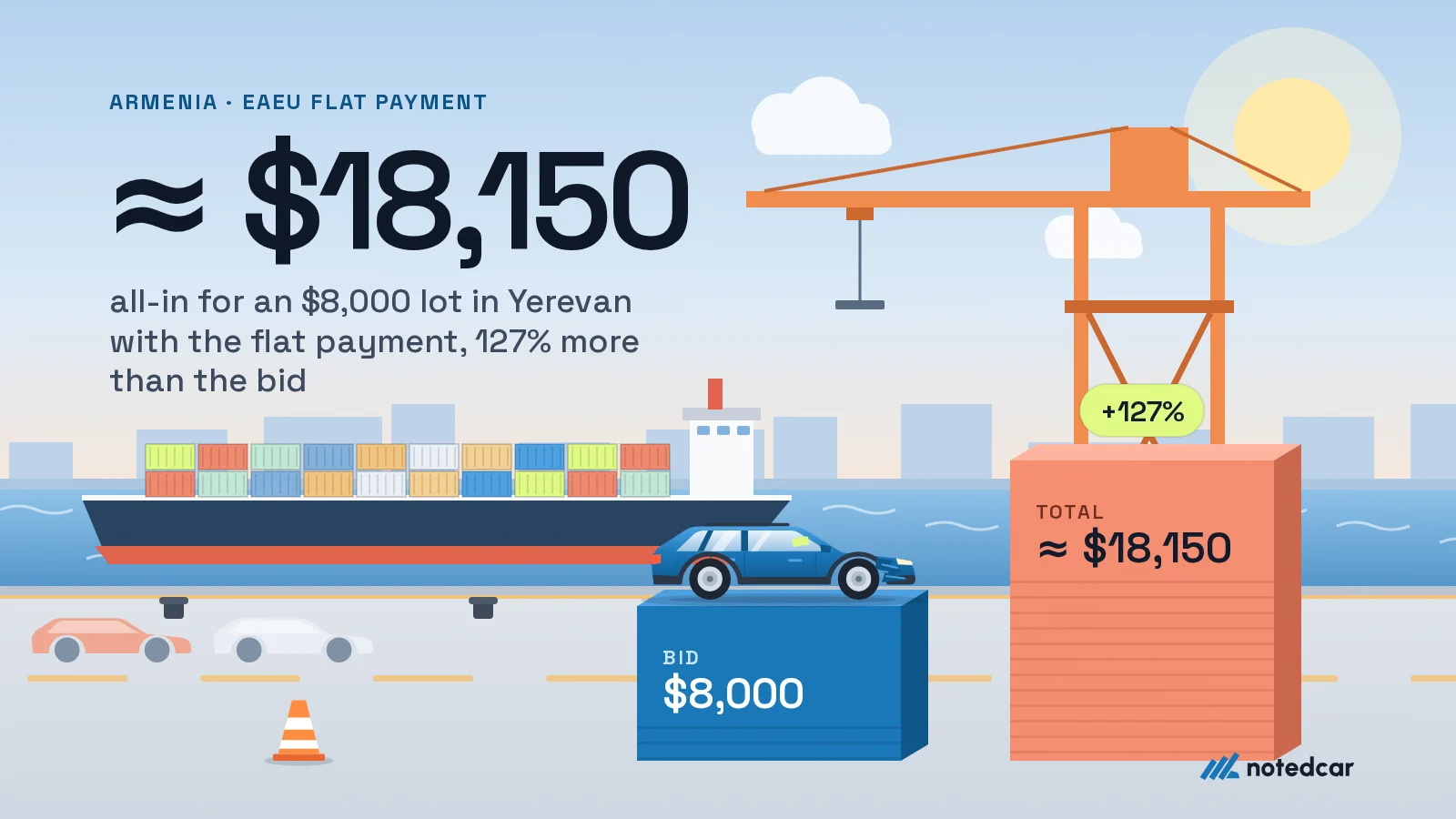
| Total in this scenario | ≈ $18,150 (+127% on the bid) |
What this changes in your bid
- Price it from year and cubic centimetres, both are on the lot card. The car’s price affects the payment only under three years.
- The 3-to-5-year window is the sweet spot, and the fifth year raises the rate by 40–100% on almost any engine.
- A damaged car pays the same as an intact one, so a cheap lot with a big engine easily becomes a trap.
- Keep a margin for the environmental tax and for repairs before the inspection.
- Check the title and VIN before bidding: the free lot report and the exact fees from a lot number.
Work out Copart and IAAI fees from a lot number and check whether a car with that title can leave the US, free and without signing up.
Calculate auction fees